Magnetic Clear Door Strips vs. Traditional PVC Curtains: Which Saves More Costs?
Published on October 16, 2025
For facility managers and procurement specialists, every investment must be justified by its return. The choice between industrial door solutions is a critical decision point, directly impacting long-term operational costs. While traditional PVC strip curtains are a long-standing staple, the emergence of magnetic clear door strips presents a compelling alternative. This guide moves beyond upfront price tags to conduct a deep-dive cost analysis, examining the Total Cost of Ownership (TCO), energy savings potential, and ROI of each solution to help you make the most cost-effective choice for your facility.

The Fundamental Difference: How Do They Actually Work?
Understanding the core operational mechanics of both traditional and magnetic PVC curtains is the first step in a comprehensive cost analysis. While they may appear similar at a glance, their method of creating an environmental seal is fundamentally different, leading to significant variations in performance, efficiency, and long-term value.
The Mechanics of Traditional PVC Curtains: Gravity, Overlap, and Manual Passage
Traditional industrial PVC strip curtains are the quintessential passive barrier. Their operational principle is rooted in two basic concepts: gravity and overlap. Each strip's weight allows it to hang vertically, but there is no active mechanism ensuring a complete reseal. Any obstruction or air pressure can prevent the strips from hanging perfectly straight, leaving gaps that compromise the environmental barrier and lead to energy loss.
The Innovation of Magnetic Strips: The Science of the Hands-Free, Self-Closing Seal
Magnetic clear door strips represent an evolutionary leap forward, transforming a passive barrier into an active sealing system. High-strength magnets are integrated along the vertical edges of each strip. When the strips are at rest, these magnets attract each other, pulling the edges together to create a continuous, gap-free seal from top to bottom. This active closing force is the key differentiator, ensuring the barrier's integrity is restored instantly after every passage.
Visualizing the Performance Gap: Why a Perfect Seal Matters
The performance gap is stark. After a forklift passes through a traditional curtain, strips may sway and settle imperfectly, leaving gaps for thermal exchange. With magnetic strips, a distinct "snap" confirms the curtain is sealed, immediately containing conditioned air and blocking contaminants. This consistency is what makes the magnetic vs. standard PVC curtain debate so critical for cost-conscious managers, as a perfect seal directly correlates to lower energy bills and better product quality.
The Upfront Investment: A Head-to-Head Price Comparison
When evaluating any new equipment, the initial purchase price is often the first metric that procurement teams scrutinize. In the comparison between magnetic and traditional PVC curtains, there is a clear difference in the upfront capital outlay.
Analyzing Per-Foot Costs: What to Expect for Standard vs. Magnetic Materials
The primary cost driver is the material itself. Standard PVC is the most economical. Magnetic PVC strips, with their integrated, hermetically sealed magnets and more complex manufacturing process, carry a significant premium, costing 1.5 to 3 times more per foot than their non-magnetic counterparts of the same grade.
Factoring in Hardware: Comparing Mounting Kit Costs (Hook-On vs. Magnetic-Ready)
For traditional curtains, the versatile and cost-effective "hook-on" mounting bracket is standard. While many magnetic systems are compatible with this hardware, some high-performance systems use proprietary tracks to ensure perfect alignment. These magnetic-ready kits can cost 20% to 50% more than a standard rail.
Is the Initial Cost Difference a Deal-Breaker for Budget-Conscious Buyers?
For a truly budget-conscious buyer focused on long-term value, the analysis must go deeper than the purchase price. The critical question isn't "Can we afford it?" but "Can we afford *not* to install a solution that saves money daily?" In high-traffic, temperature-controlled areas, the payback period for a magnetic system's premium can be surprisingly short, often under a year.

The Real Savings: Calculating Long-Term ROI on Energy Efficiency
The true financial narrative unfolds over the operational lifespan of the door solution. The most significant and quantifiable long-term cost saving is derived from energy efficiency, especially in temperature-controlled environments.
Quantifying Energy Loss: How Gaps in Traditional Curtains Inflate HVAC Bills
Gaps in traditional curtains create a pathway for thermal convection. In a cold storage facility, cold air flows out while warm air flows in, placing a constant load on the refrigeration system. A facility with multiple gapping curtain doors could be wasting thousands of dollars per year in excess energy costs.
Modeling Energy Savings: The Impact of a Magnetic Seal in Cold Storage PVC Strip Curtains
A magnetic seal drastically reduces air infiltration. Upgrading from a traditional to a magnetic curtain can cut air leakage through the doorway by over 90%. This directly translates into a reduced workload for the refrigeration system, fewer defrost cycles, and significant, calculable savings on the electricity bill.
Case Study: Projecting Payback Period in a High-Traffic Refrigerated Warehouse
In a realistic scenario, the higher upfront cost of magnetic strips can be fully recovered in just 9-12 months through direct energy savings. From that point forward, the system generates thousands of dollars in pure operational savings annually for that single doorway, making it a high-return investment.
Durability and Lifespan: Which Curtain Lasts Longer in Heavy-Duty Environments?
The lifespan of an industrial curtain is a critical component of its Total Cost of Ownership (TCO). Heavy-duty environments place extreme stress on PVC strips, and a solution that requires frequent replacement can become expensive.
Wear and Tear Analysis: The Effect of Forklift Traffic on Ribbed vs. Smooth Strips
Forklift traffic is highly destructive. Smooth strips scratch easily, reducing visibility and creating safety hazards. Ribbed PVC, with raised ridges to absorb impact, preserves visibility for much longer and is a superior choice for any high-traffic application, whether traditional or magnetic.
Magnetic Edge Integrity vs. Strip Fraying: Comparing Failure Points
Traditional strips fail by tearing at the mounting points or fraying and curling at the edges. In quality magnetic strips, the magnets are hermetically sealed and do not wear out. The magnetic edge is often more robust and less prone to the gradual degradation seen in traditional strips.
Total Cost of Ownership (TCO): Factoring in Replacement Frequency and Costs
A 5-year TCO calculation often shows that the magnetic curtain is dramatically more cost-effective. The "cheaper" traditional curtain becomes a financial liability due to higher energy consumption and a more frequent replacement cycle. The savings in TCO can be over $9,000 per doorway in some cases.

Hygiene and Contamination Control: A Critical Factor for Food and Pharma
In industries like food processing and pharmaceuticals, environmental control is a cornerstone of product safety and regulatory compliance. The doorway barrier must effectively prevent the ingress of contaminants.
The Problem with Gaps: How Traditional Curtains Allow Pest and Dust Ingress
Gaps in traditional curtains are open invitations for insects, rodents, and dust. This directly undermines a facility's Integrated Pest Management (IPM) program and can lead to non-compliance citations from health inspectors.
The Magnetic Advantage: Creating a Superior Barrier for Integrated Pest Management (IPM)
The self-closing, gap-free seal of magnetic strips offers a decisive advantage. It creates a formidable barrier that significantly enhances the "exclusion" component of an IPM program, reducing reliance on chemical treatments and ensuring a cleaner environment.
Hands-Free Passage: Reducing Cross-Contamination and Supporting HACCP/GMP Compliance
Hands-free passage is a core principle of modern hygiene. Magnetic curtains eliminate the need for staff to touch door surfaces, directly reducing the risk of cross-contamination and supporting compliance with HACCP and GMP standards.
Operational Efficiency: Impact on Workflow and Employee Productivity
The choice of door curtain has a direct impact on the speed and efficiency of a facility's operations. Friction or delays at doorways can add up to significant lost time and reduced productivity.
Measuring Cycle Times: The Drag of Manual Passage with Traditional Strips
Pushing through heavy, overlapping traditional strips adds seconds to every passage. For a busy doorway, this can add up to over 200 hours of lost productivity per year, representing a significant hidden cost.
Streamlining Traffic Flow: The Benefit of Automatic Closure in Logistics Hubs
Magnetic curtains streamline traffic. The automatic closure allows operators to maintain a more consistent speed, boosting throughput and reclaiming hundreds of hours of productive time annually per doorway.
Enhancing Safety: How Uninterrupted Visibility Prevents Collisions
Visibility is safety. Traditional strips quickly become scratched and opaque. Magnetic curtains, by sustaining less abrasive contact, tend to stay clearer for longer, providing a better line of sight and reducing the risk of costly forklift collisions.
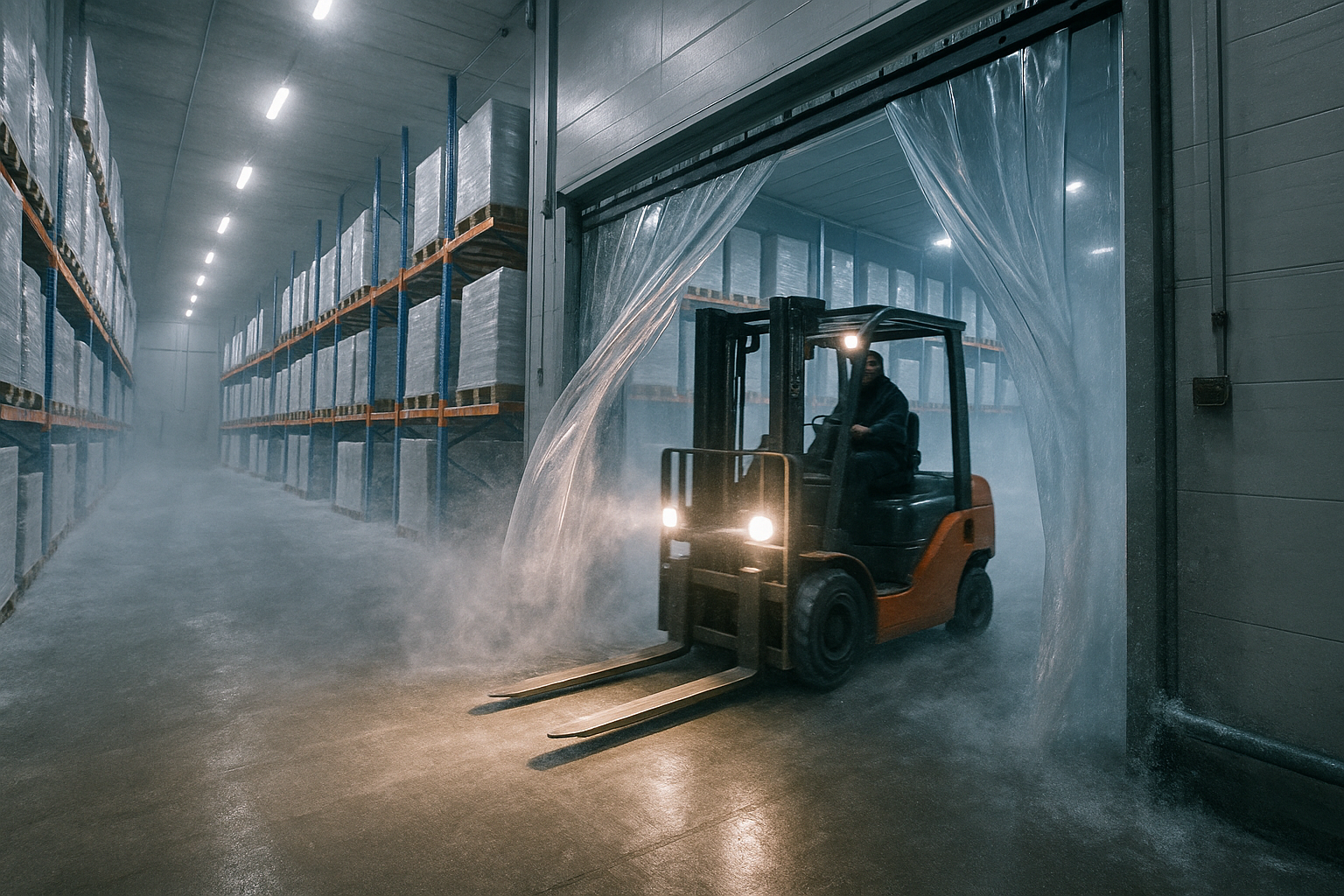
Application Deep Dive: Best Use Cases for Cold Storage and Freezers
Nowhere is the choice of door solution more critical than in cold storage. These environments demand exceptional thermal efficiency, durability in extreme temperatures, and absolute reliability.
Why Polar Grade PVC is Non-Negotiable for Both Curtain Types
Standard PVC becomes brittle and will shatter in sub-zero temperatures. For any freezer application, it is essential to use Polar Grade (or Low-Temp) PVC, which is formulated to remain flexible down to -40°F/C. This applies to both traditional and magnetic systems.
Reducing Ice Buildup: The Superior Seal of Magnetic Freezer Grade PVC Strips
Ice buildup is caused by the infiltration of warm, moist air. By creating a near-airtight seal, magnetic curtains drastically reduce this infiltration, resulting in less ice, safer floors, and more efficient refrigeration systems with fewer energy-intensive defrost cycles.
Maintaining the Cold Chain: Temperature Stability in High-Traffic Freezer Doors
The cold chain is vital for product safety. Magnetic curtains maintain far more stable and consistent temperatures by resealing instantly after passage. This minimizes thermal fluctuations, protects product quality, and reduces the risk of spoilage.
Noise Abatement Showdown: Which Option Better Controls Sound?
Industrial curtains are often used for noise abatement. The effectiveness of a sound barrier is determined not by the material alone, but by the integrity of its seal.
PVC as an Acoustic Barrier: Baseline Noise Reduction Expectations
As a dense, flexible material, PVC has inherent sound-dampening properties. A thick PVC curtain can provide a noticeable reduction in perceived loudness, helping facilities meet OSHA noise exposure limits.
The Sealing Factor: How Gaps in Traditional Curtains Leak Sound
Sound, like air, follows the path of least resistance. Even a tiny gap in a barrier can let through 50% of sound energy. The inherent gaps in traditional curtains severely compromise their effectiveness as an acoustic solution.
Evaluating Decibel Reduction for Quieter Work Environments
By eliminating sound leaks, magnetic curtains provide a much more effective and reliable acoustic barrier. The additional 5-8 dB of reduction compared to a traditional curtain can make the difference between a hazardous and a safe work environment.
Installation Complexity and Costs: A Facility Manager's Perspective
The complexity and cost of installation are major practical considerations for any facility manager. A simple installation process saves time and reduces downtime.
A Look at Mounting Systems: Universal Hook-On Rails vs. System-Specific Hardware
Most traditional and many magnetic systems use the same simple, user-friendly "hook-on" mounting hardware. Some high-performance magnetic systems use proprietary tracks, which may be slightly more complex but are engineered for optimal performance.
DIY vs. Professional Install: Estimating Labor Time and Costs
Most PVC strip curtain systems, both traditional and magnetic, are designed for easy DIY installation by an in-house maintenance team. For a standard doorway, two workers can typically complete the job in 1-2 hours, keeping labor costs to a minimum.
Are Magnetic Systems More Complicated to Set Up?
This is a common misconception. The installation of a magnetic curtain is a manageable task, with a difficulty level that is, in most cases, identical or only marginally greater than that of a traditional system. The focus should be on long-term benefits, not a perceived installation hurdle.
Maintenance and Repair: A Comparison of Long-Term Upkeep
Easy and cost-effective maintenance is key to a low TCO. The ability to clean and repair a system quickly extends its life and value.
Daily Cleaning and Care: Are There Differences in Hygiene Routines?
The basic cleaning process is identical for both. However, magnetic curtains can be easier to clean as they "unzip" for full access and may stay cleaner to begin with due to their superior seal against dust.
Sourcing Replacement Parts: The Ease of Replacing Individual Strips
The modular design of both systems allows for the quick and inexpensive replacement of single damaged strips. This is a major advantage over systems that require full replacement, dramatically extending the lifecycle of the investment.
Assessing Long-Term Integrity: Inspecting Magnets vs. Checking for Curls and Tears
Inspecting a traditional curtain involves looking for physical degradation like curls and tears. Inspecting a magnetic curtain is a pass/fail performance test: does it seal or not? This can make performance assessment more definitive.
Sourcing Strategy: Leveraging OEM for Cost and Customization
Sourcing directly from an Original Equipment Manufacturer (OEM) can unlock significant advantages in terms of price, customization, and support, maximizing the return on your investment.
The Benefits of Factory-Direct Wholesale on Both Product Types
Sourcing factory-direct cuts out distributor markups, resulting in substantial cost savings. This can bring the price of superior magnetic systems down to a level competitive with the distribution price of traditional curtains.
Custom Sizing: Does One Option Offer More Flexibility for Non-Standard Doors?
Both traditional and magnetic systems are highly customizable when sourced from an OEM. Manufacturers can create solutions for any size or shape of doorway, ensuring a perfect fit and optimal performance where off-the-shelf products would fail.
Negotiating Bulk Pricing: How Volume Affects the Cost-Benefit Equation
For large projects, bulk pricing can dramatically shrink the investment premium for magnetic curtains, making the TCO and energy efficiency arguments even more overwhelming. It turns the "more expensive" option into the smartest choice.
The Final Verdict: Which Curtain Offers the Best Value for YOUR Facility?
After a comprehensive analysis, the final decision rests on aligning the right solution with the specific needs of your facility. There is no single "best" curtain, only the "best fit" for a given application.
Choose Traditional PVC If: Your Priority is Lowest Upfront Cost in Low-Traffic Areas
If your budget is the absolute #1 priority, the traffic is low, and there is no significant temperature differential, a traditional PVC curtain remains a pragmatic and sensible choice. It provides a basic, functional barrier for the minimum possible outlay.
Choose Magnetic Strips If: Your Priority is Lowest TCO and Maximum Efficiency
For any facility where operational costs, energy consumption, hygiene, and productivity are key metrics, magnetic clear door strips are the clear winner. The higher initial investment is an investment in technology that actively saves money and improves operations daily.
A Decision Matrix for Procurement Managers: Matching the Solution to the Need
Use the matrix below to score your application's needs. The column with the most circles points to your most logical choice. For each row, assess whether the priority is low or high for your specific doorway.
| Priority | Low Priority / Low Impact (→ Traditional) | High Priority / High Impact (→ Magnetic) |
|---|---|---|
| Budget Focus | Lowest Upfront Purchase Price | Lowest Total Cost of Ownership (TCO) |
| Traffic Level | Low ( < 50 passages/day) | High ( > 100 passages/day) |
| Energy Savings | Not a primary concern (low ΔT) | Critical (Freezer/Cooler/HVAC) |
| Hygiene Control | Basic dust control needed | Strict Pest/Contaminant/GMP required |
| Workflow Impact | Minor inconvenience is acceptable | Maximum speed & efficiency are key |
| Noise Control | Not a factor | Need to isolate a noisy area |
| Safety/Visibility | Low forklift/pedestrian interaction | High-traffic, blind corners exist |
The Bottom Line
The debate between magnetic and traditional PVC curtains is not about which is "better," but which is the smarter investment for a specific application. While traditional curtains offer the lowest barrier to entry with their minimal upfront cost, the data points clearly to magnetic clear door strips as the superior long-term financial choice for any facility where energy efficiency, hygiene, and operational uptime are critical metrics. The unparalleled seal integrity translates directly into reduced energy consumption, minimized product spoilage, and a safer, more productive workflow.
Ready to calculate the ROI for your facility? As a leading OEM, we provide factory-direct pricing on both traditional and magnetic industrial PVC strip curtains. Contact our specialists today for a custom quote on your bulk or OEM order and discover how the right door solution can drive down your operational costs.
Technical Specifications at a Glance
| Attribute | Traditional PVC Curtains | Magnetic PVC Door Strips | Key Procurement Insight |
|---|---|---|---|
| Material Composition | Standard, Polar (Low-Temp), or Ribbed PVC | Standard, Polar (Low-Temp), or Ribbed PVC with hermetically sealed Neodymium/Ferrite magnets | Material choice is application-dependent for both; the core difference is the embedded magnet technology. |
| Thermal Resistance (R-value) | Low (R-1 to R-2); effective R-value is compromised by air gaps between strips. | Low (R-1 to R-2); effective R-value is maximized due to a near-airtight magnetic seal. | Magnetic strips deliver superior effective thermal performance by eliminating heat transfer via convection. |
| Automatic Closure Mechanism | None (Gravity-dependent overlap) | Yes (Embedded magnets actively pull strips together for a full-length seal) | The automatic seal is the primary driver of energy savings and hygiene benefits. |
| Hygiene Compliance | Moderate; depends on strip overlap and condition. Allows pest/dust ingress through gaps. | High; tight seal creates a formidable barrier to pests, dust, and airborne contaminants. | For food-grade (FDA) or cleanroom environments, the magnetic seal provides superior compliance assurance. |
| Typical ROI Period | 12-24 months (primarily from basic temperature separation) | 4-9 months (accelerated by superior energy savings and reduced product loss) | Magnetic strips offer a significantly faster payback, making them a more compelling long-term investment. |
| MOQ/OEM Availability | Widely available from OEM suppliers for custom sizes and bulk orders. | Widely available from OEM suppliers for custom sizes and bulk orders. | Both are highly customizable when sourced factory-direct, allowing for tailored solutions. |
People Also Ask: Expert Answers to Common Questions
1. What are the key benefits of magnetic PVC strip curtains compared to traditional ones?
Magnetic PVC strip curtains offer a superior, self-closing seal that significantly improves temperature control, energy efficiency, and hygiene by preventing gaps. This automatic closure enhances workflow by allowing for hands-free passage, blocks pests and dust more effectively, and provides a faster return on investment through lower operational costs in high-traffic industrial environments. The active seal is the primary advantage over the passive overlap of traditional curtains.
2. How much energy can industrial PVC strip curtains save?
Properly installed industrial PVC strip curtains can reduce energy costs by 30-50% in temperature-controlled environments. By creating an effective thermal barrier at doorways, they minimize the workload on HVAC and refrigeration systems, which no longer have to run constantly to compensate for escaping conditioned air. This leads to substantial and measurable savings on monthly electricity bills. Magnetic curtains are at the higher end of this savings spectrum due to their superior seal.
3. Are PVC strip curtains a cost-effective solution for warehouses?
Yes, PVC strip curtains are a highly cost-effective solution for temperature and environmental control in warehouses. Their upfront cost is significantly lower than that of rigid, high-speed doors. They deliver exceptional value by conserving energy, protecting inventory from dust and pests, and creating more comfortable work zones, all of which contribute to a healthier bottom line.
4. In which industrial applications are magnetic PVC strip curtains most beneficial?
Magnetic PVC strip curtains are most beneficial in environments requiring strict hygiene and temperature control. This includes cold storage and freezer doors, food processing facilities (HACCP/GMP compliance), pharmaceutical cleanrooms, and high-traffic logistics hubs. In these applications, the reliability of the automatic, gap-free seal is critical for protecting product quality, ensuring safety, and maximizing energy savings.
5. What material is required for low-temperature freezer environments?
For any sub-zero application, it is essential to use Polar Grade (also called Low-Temp) PVC. This material is specifically formulated with special plasticizers that allow it to remain flexible and resist cracking at temperatures down to -40°F/C. Using standard PVC in a freezer will result in it becoming brittle and shattering, rendering the door useless.
6. Can I get these curtains in custom sizes?
Yes, a key advantage of sourcing from an OEM manufacturer is the ability to get both traditional and magnetic PVC strip curtains custom-made to your exact door dimensions. This ensures a perfect fit for non-standard openings, which is crucial for maximizing the curtain's performance in controlling temperature, dust, and pests. Customization ensures you are not trying to make a standard-sized product fit a unique space.