INDUSTRIAL EQUIPMENT
The Procurement Guide to Industrial Magnetic Door Strips: Boosting ROI Through Safety and Efficiency
A comprehensive guide for facility managers and procurement specialists on selecting, specifying, and justifying the investment in magnetic PVC strip curtains to enhance operational performance.

In any high-traffic industrial facility—be it a warehouse, cold storage unit, or manufacturing plant—the control of environment, safety, and workflow efficiency are paramount. Traditional strip doors have long been a solution, but they come with inherent flaws: gaps, energy loss, and wear. The next evolution, magnetic PVC strip curtains, directly addresses these shortcomings, offering a self-closing, perfect seal that delivers a significant return on investment. This guide provides a deep dive into why magnetic door strips are a superior choice and how to procure the right solution for your specific operational needs.
The Core Innovation: Why Self-Closing Magnetic Seals Outperform Standard Strip Doors
The fundamental advantage of magnetic strip curtains lies in a simple yet powerful innovation: an active, automated closure system. Unlike standard PVC strips that hang passively and rely on gravity to fall back into place, magnetic strips are engineered with powerful magnets hermetically sealed along their edges. This creates a system that actively pulls itself shut, forming a complete, gap-free barrier every time someone or something passes through.

The Science of the Hands-Free Seal: Deconstructing the Magnetic Closure Mechanism
The magic is in the engineering. High-strength neodymium or ferrite magnets are strategically placed and RF-welded into waterproof seams. When the strips are disturbed, they swing back and the magnetic fields engage, drawing the edges together with a firm "snap." This creates an immediate, reliable seal that contains temperature, dust, noise, and fumes far more effectively than overlapping, non-magnetic strips that can be pushed aside and remain open.
Performance Gap Analysis: Quantifying Leakage in Standard vs. Magnetic Strips
Studies and field tests demonstrate a substantial performance gap. Standard strip doors can allow significant air leakage, leading to energy losses of up to 50% in temperature-controlled environments. Gaps also permit cross-contamination. Magnetic strips, by creating a virtually airtight seal, dramatically reduce this leakage. This translates directly to lower energy bills, more stable temperatures, and a cleaner, more controlled environment.
Key System Components: Specifying Strips, Magnets, and Mounting Hardware
A complete system consists of three parts: the PVC strips (specified by material grade, thickness, and width), the integrated magnets, and the mounting hardware. The hardware, typically made of galvanized or stainless steel, is just as crucial. Universal mounting systems allow for both wall (face) and in-jamb (header) installation, providing flexibility for any doorway architecture.
Calculating the ROI: A Financial Framework for Your Investment
While magnetic strip curtains may have a higher initial cost than their standard counterparts, the return on investment is rapid and multifaceted. For procurement managers, building a business case is straightforward when you quantify the savings.
Modeling Energy Savings: A Calculation for Cold Storage & HVAC Efficiency
The largest ROI driver is energy efficiency. In a cold storage facility, every degree of temperature fluctuation forces compressors to work harder. By minimizing air exchange, magnetic curtains reduce compressor run-time, leading to verifiable reductions in monthly electricity costs. A simple calculation can model this: (Energy Cost x Compressor Run-Time Reduction %) = Monthly Savings. Over a year, these savings often exceed the initial investment.
Reducing Product Spoilage: The Impact of Superior Contamination Control
For food, pharmaceutical, or electronics manufacturing, product integrity is non-negotiable. A superior seal prevents airborne contaminants like dust, insects, and humidity from migrating between zones. This reduces spoilage rates and product rejection, a direct saving that adds to the ROI. In industries with strict regulatory compliance, this feature isn't just a cost-saver; it's a necessity.
Total Cost of Ownership (TCO): Analyzing Beyond the Upfront Unit Price
TCO for magnetic curtains is lower over the long term. Their durable construction and reduced wear (as they seal without forceful impact) mean a longer lifespan. Furthermore, the ongoing savings in energy, product protection, and even reduced cleaning time (from better dust control) far outweigh the initial price difference compared to less effective solutions.
Interested in Bulk Pricing?
We offer competitive pricing for large volume orders and multi-facility rollouts. Our OEM program provides tailored solutions to standardize quality across all your locations.
Contact Our Sales TeamMaterial Science Deep Dive: Selecting the Right PVC for Your Application
Choosing the correct PVC material is critical for performance and longevity. Not all PVC is created equal, and specifying the wrong type can lead to premature failure and safety hazards.
Standard vs. Low-Temp (Polar) Grade: A Temperature-Based Decision Matrix
This is the most crucial decision. Standard Grade PVC is suitable for environments from 0°F to 150°F (-18°C to 66°C). However, in freezers or external winter applications, it will become brittle and crack. For these, Low-Temp (Polar) Grade PVC is mandatory. It's formulated to remain flexible down to -40°F/C, ensuring durability and a proper seal in sub-zero conditions.
Ribbed vs. Smooth Strips: A Durability Analysis for Forklift Traffic
For doorways with heavy, repeated forklift traffic, Ribbed PVC strips are the superior choice. The raised ribs on both sides take the brunt of impacts and scuffs, preserving the clarity of the main strip surface. This extends visibility and the product's aesthetic life. For pedestrian or light cart traffic, Smooth PVC strips offer excellent clarity and are easier to clean.
Specialized Formulations: Anti-Static, Welding Grade, and Anti-Insect Options
Beyond standard options, our OEM capabilities allow for specialized solutions. Anti-Static PVC is essential for data centers or electronics manufacturing to prevent electrostatic discharge. Welding Grade PVC (typically tinted) protects personnel from harmful UV rays during welding processes. Anti-Insect Yellow PVC is designed to deter flying insects, making it ideal for food processing facilities and restaurants.
Application Focus: Cold Storage and Refrigerated Environments
In the cold chain industry, maintaining temperature integrity is the prime directive. Magnetic strip curtains are a game-changer for these applications, providing an affordable and effective barrier that doesn't impede workflow.

Preserving the Cold Chain: Ensuring Critical Temperature Stability
The self-closing, airtight seal of magnetic curtains drastically reduces temperature exchange between ambient and refrigerated zones. This means less temperature fluctuation, ensuring that sensitive products like food, pharmaceuticals, and chemicals remain within their required temperature range, preserving quality and safety.
How a Superior Seal Reduces Frost Buildup and Defrost Cycle Frequency
Warm, moist air infiltrating a freezer is the primary cause of frost and ice buildup on evaporator coils and surfaces. By creating a superior seal, magnetic curtains minimize this infiltration. The result is significantly less frost, which in turn reduces the frequency and duration of energy-intensive defrost cycles, adding another layer of operational savings.
Meeting Food Safety Compliance (HACCP, FDA) with Freezer-Grade Curtains
For facilities governed by HACCP, FDA, or USDA regulations, our Polar Grade PVC materials are a compliant choice. They are formulated to be safe for food environments and help maintain the physical separation required to prevent cross-contamination, a critical control point in any food safety plan.
Application Focus: Food Processing & Pharmaceutical Cleanrooms
In environments where hygiene is paramount, controlling airborne particulates is a constant challenge. Magnetic strip curtains provide an effective solution for maintaining clean zones without creating the bottlenecks associated with solid doors.

Minimizing Airborne Particulates for ISO Cleanroom Standard Compliance
The tight seal achieved by magnetic strips helps maintain pressure differentials between cleanrooms and adjacent areas. This is crucial for meeting ISO 14644-1 standards by preventing dust, microbes, and other contaminants from entering controlled spaces. Their smooth surface is also easy to clean and sanitize.
Enhancing Hygiene Protocols with Hands-Free, No-Contact Passage
In a hygienic environment, every touchpoint is a potential source of contamination. Because magnetic curtains are hands-free—personnel and carts simply push through—they eliminate the need to touch door handles. The strips then close automatically, preserving the integrity of the clean zone without manual intervention.
The Role of Magnetic Curtains in Integrated Pest Management (IPM) Programs
An unbroken seal is the first line of defense in any IPM program. Magnetic curtains create a reliable barrier against insects, rodents, and birds, preventing them from entering processing or storage areas from loading docks or other exterior-facing openings. Yellow anti-insect formulations can further enhance this protection.
Application Focus: Warehouses and High-Traffic Logistics Hubs
For warehouses, distribution centers, and logistics hubs, the priorities are safety, speed, and environmental control. Magnetic curtains excel in these high-volume, high-impact settings.
Enhancing Safety and Visibility for Forklift and Pedestrian Routes
Crystal-clear PVC strips provide excellent visibility, allowing forklift operators and pedestrians to see what—or who—is on the other side. This dramatically reduces the risk of collisions at busy intersections. Unlike solid or high-speed roll-up doors, strip curtains allow for constant situational awareness.
Streamlining Workflow: The Impact of Self-Closing Doors on Cycle Times
In logistics, seconds matter. Waiting for a mechanical door to open and close slows down every cycle. With magnetic strip curtains, traffic flows without interruption. Forklifts and personnel can pass through without stopping, and the door closes instantly behind them. This seamless movement translates to higher throughput and greater operational efficiency.
Noise Abatement Strategies: Using PVC Curtains as an Acoustic Barrier
Thick PVC material is an excellent sound-dampening agent. Installing heavy-duty magnetic curtains can reduce noise transmission between a noisy production floor and a quieter office or staging area by up to 17dB. This creates a more comfortable and safer work environment by reducing overall noise exposure.
Procurement Strategy: Leveraging OEM & Bulk Purchasing for Maximum Value
To maximize your return on investment, sourcing directly from an Original Equipment Manufacturer (OEM) offers significant advantages over purchasing from a reseller.
The OEM Advantage: Cost, Quality Control, and Customization
Partnering with an OEM supplier like us means you bypass distributor markups, resulting in a lower unit cost, especially on bulk orders. You also gain direct access to our quality control systems and material expertise. Most importantly, it unlocks a full spectrum of customization, from non-standard sizes to specialized material formulations for your unique application.
Specifying Custom-Sized Solutions for Non-Standard Openings
Few facilities have perfectly standard doorways. As an OEM, we manufacture curtains to your exact width and height specifications, ensuring a perfect fit and maximum seal efficiency. Pre-punched strips and pre-assembled hardware make installation faster and simpler for your maintenance team.
Simplifying Logistics for Multi-Facility Procurement & Standardization
For corporations with multiple sites, our OEM program allows you to standardize the quality and specifications of door curtains across all locations. We can manage the logistics of large-scale rollouts, ensuring consistent product and performance, simplifying procurement into a single, efficient process.
A Facility Manager's Guide to Installation & System Integration
Proper installation is key to unlocking the full performance benefits of your magnetic strip curtains. While straightforward, following a clear process ensures a perfect seal from day one.
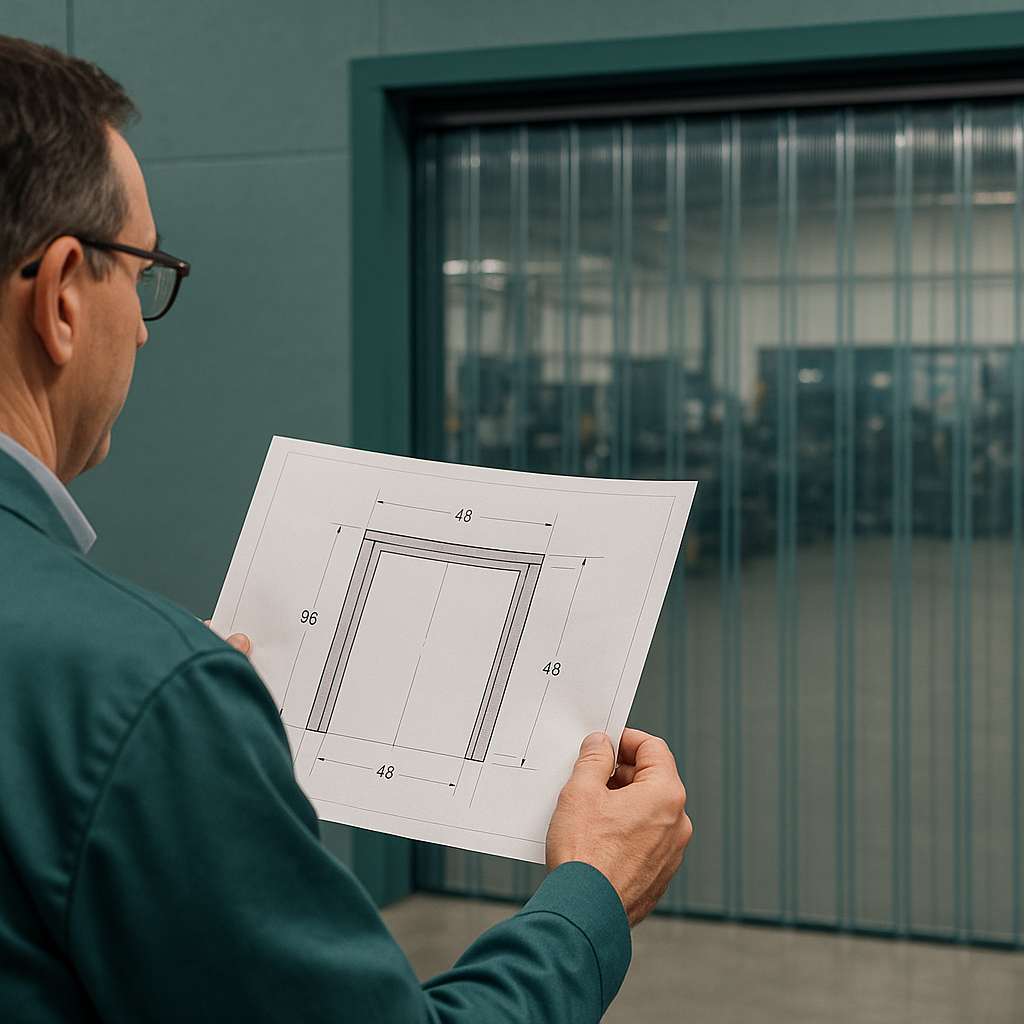
Pre-Installation Checklist: Accurate Measurement and Header Inspection
Before ordering, measure the opening's width and height carefully. Ensure the header area above the door is structurally sound and provides enough space for the mounting hardware. Note any obstructions like pipes or conduits. Providing accurate measurements is the first step to a successful installation.
Installation Guide: Wall Mount vs. In-Jamb Mounting Hardware
Your choice of mounting depends on your door frame. Wall Mount (or Face Mount) hardware is installed on the wall above and around the opening, which is the most common method. In-Jamb (or Header Mount) hardware is installed within the door frame itself. Our universal hardware typically supports both options.
Post-Installation Checks for a Perfect Seal and Optimal Function
Once the strips are hung, check for a complete seal. The strips should hang straight and the magnets should engage along the full length of the seams. Ensure there is sufficient overlap between strips (typically 50% or more) to prevent gapping. The bottom of the strips should just touch the floor for an optimal environmental barrier.
Long-Term Performance: Maintenance and Lifecycle Management
Magnetic PVC strip curtains are built for durability, but a simple maintenance routine will extend their life and ensure they continue to perform at their best.
Creating a Simple Cleaning Schedule for Transparency and Hygiene
Periodically clean the strips with a mild soap and water solution to maintain transparency and hygiene. Clear visibility is a key safety feature, and regular cleaning is essential, especially in food or cleanroom environments. Avoid harsh chemical cleaners that could damage the PVC.
How to Inspect for Wear and Tear in Heavy-Duty Environments
Regularly inspect the strips for deep scratches, tears, or damage, particularly at the bottom where they may interact with traffic and debris. Also check that the mounting hardware remains secure and that the magnets are still functioning correctly. Early detection of issues can prevent larger problems.
Sourcing and Replacing Individual Strips to Extend System Lifespan
One of the benefits of strip curtains is modularity. If a single strip becomes damaged, you don't need to replace the entire door. Individual replacement strips can be ordered and easily installed, making maintenance cost-effective and extending the overall lifespan of the system.
Navigating Compliance: Meeting OSHA, FDA, and Environmental Standards
Our magnetic strip curtains are designed and manufactured to help you meet a wide range of regulatory requirements common in industrial settings.
Adhering to OSHA Guidelines for Workplace Safety and Visibility
OSHA requires employers to provide a safe workplace. The high visibility of clear PVC strips and the prevention of collisions align directly with these guidelines. By separating work areas and controlling hazards like noise and fumes, strip curtains contribute to a safer, more compliant facility.
Material Specifications for FDA and USDA Requirements in Food-Grade Environments
We offer materials that are accepted for use in federally inspected food processing and packaging plants. These materials meet FDA 21 CFR standards and are formulated to be safe for incidental contact with food products, supporting your facility's HACCP and food safety programs.
Fire Retardancy and Emergency Egress Considerations
For applications requiring fire-retardant materials, we can supply PVC that meets NFPA-701 and CFM standards. Importantly, strip curtains allow for easy emergency egress, as personnel can push through them easily from any point, unlike solid doors.
Comparative Analysis: Magnetic Curtains vs. Alternative Door Solutions
When evaluating door solutions, it’s important to compare not just the upfront cost, but the total value proposition. Here’s how magnetic curtains stack up.
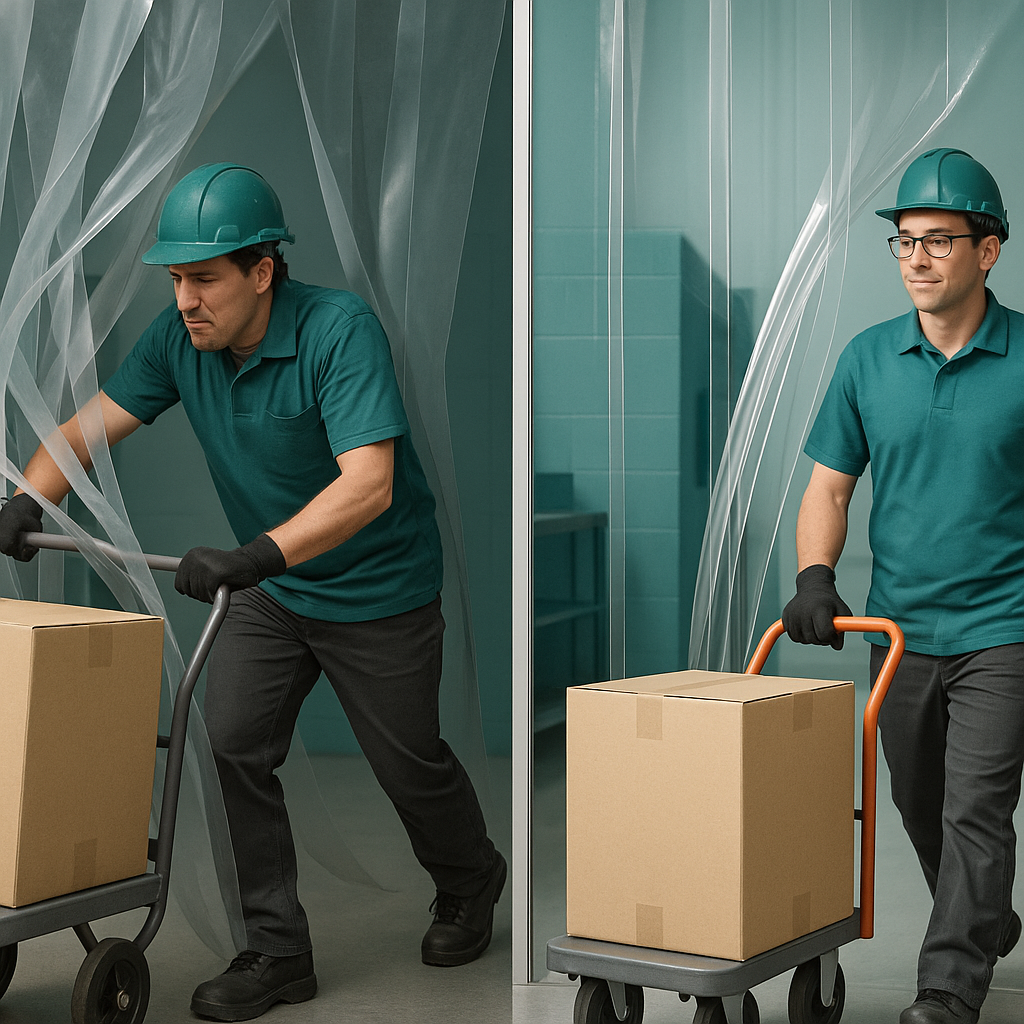
Cost-Benefit Analysis: Magnetic Strips vs. High-Speed Roll-Up Doors
High-speed roll-up doors offer excellent sealing but come at a significantly higher capital cost, require electricity, and have complex mechanical parts that demand expensive maintenance. Magnetic strip curtains provide a comparable environmental seal at a fraction of the cost, with virtually no maintenance and zero energy consumption.
Environmental Control: Magnetic Curtains vs. High-Energy Air Curtains
Air curtains attempt to create a barrier using a constant stream of high-velocity air. They are energy-intensive and less effective at stopping physical contaminants, pests, and significant temperature differentials. A magnetic physical barrier is far more effective and consumes no power.
Seal Integrity Showdown: Magnetic vs. Standard (Non-Magnetic) Hook-On Strips
This is the most direct comparison. Standard strips hang loose and are easily displaced, leaving persistent gaps that leak energy and let in contaminants. The active magnetic seal of our curtains closes these gaps every time, providing demonstrably superior performance and a faster ROI. For any application where environmental control is a priority, magnetic is the clear winner.
Finalizing Your Specification: A Checklist for a Perfect Quote
Ready to upgrade your facility? Use this checklist to gather the necessary information. Providing these details to our team will allow us to generate a fast, accurate quote for the perfect solution.
Step 1: Define Your Operational Environment (Temperature, Traffic, Contaminants)
What is the temperature range (freezer, ambient, or hot)? What kind of traffic will pass through (pedestrians, carts, forklifts)? Are you trying to control dust, fumes, noise, or something else? This determines the material grade and thickness.
Step 2: Choose Material, Thickness, and Overlap Percentage
Based on Step 1, select Standard or Polar Grade PVC. Choose smooth or ribbed. Specify thickness (e.g., .080" for light traffic, .160" for heavy-duty). Determine the required overlap (e.g., 50% for standard, 100% for maximum seal).
Step 3: Gather Door Dimensions and Specify Hardware Requirements
Measure the clear opening width and height of your doorway. Decide if you need wall mount or in-jamb hardware. Finally, specify the hardware material—Galvanized Steel for general use or Stainless Steel for food-grade or wash-down areas.
Product Technical Specifications
| Entity | Attribute | Value |
|---|---|---|
| Material | PVC Grade | Standard, Polar (Low-Temp), Ribbed, Anti-Static, Welding Grade, Anti-Insect (Yellow) |
| Thickness | .080" (2mm), .120" (3mm), .160" (4mm) | |
| Width | 8" (200mm), 12" (300mm), 16" (400mm) | |
| Performance | Temperature Range (Standard) | 0°F to 150°F / -18°C to 66°C |
| Temperature Range (Polar) | -40°F to 140°F / -40°C to 60°C | |
| UV Resistance | Formulated with UV inhibitors for outdoor/sunlight exposure | |
| Sound Abatement | Up to 17dB reduction, dependent on thickness and overlap | |
| Construction | Magnet Type | Neodymium or Ferrite, hermetically sealed via RF-welding into waterproof seams |
| Mounting Hardware | Galvanized Steel (Standard), Stainless Steel 304/316 (Food/Pharma/Wash-down) | |
| Mounting Options | Wall Mount (Face Mount), In-Jamb (Header Mount), Universal Mount | |
| Overlap Options | 50% (Standard), 67% (Heavy Duty), 100% (Maximum Seal) | |
| Compliance | Certifications | REACH Compliant, RoHS Compliant, Phthalate-Free options available |
| Food/Health Safety | FDA 21 CFR & USDA accepted materials available upon request | |
| Fire Retardancy | Meets NFPA-701 & CFM standards available upon request | |
| Procurement | Customization | Custom lengths, widths, and punching available |
| Lead Time | Varies by order size and customization; inquire for specifics | |
| Minimum Order Quantity (MOQ) | Applicable for bulk rolls and OEM orders; contact for details |
B2B Procurement FAQ
1. What is the primary difference between magnetic and standard PVC strip curtains?
The key difference is the self-closing mechanism. Magnetic curtains have magnets embedded in the edges that actively pull the strips together for a complete, gap-free seal. Standard curtains rely only on gravity and often leave gaps, compromising temperature and contaminant control.
2. What PVC grade do I need for a walk-in freezer application?
For any sub-zero application, you must specify Low-Temp or Polar Grade PVC. This material is formulated to remain flexible at temperatures down to -40°F/C. Using standard PVC will cause it to become brittle and fail.
3. Can we order custom sizes for our non-standard doorways?
Yes. As an OEM supplier, we specialize in manufacturing custom-sized curtains tailored to your facility's exact dimensions. This ensures a perfect fit and optimal sealing performance for any opening.
4. What are the typical lead times and Minimum Order Quantities (MOQs) for a bulk order?
Lead times and MOQs vary based on the scope of the order, material availability, and level of customization. We recommend contacting our sales team with your specifications for a precise quote and delivery schedule.
5. How do magnetic curtains hold up to heavy forklift traffic?
They are designed for heavy industrial use. For frequent forklift traffic, we recommend specifying thicker strips (e.g., .120" or .160") and a ribbed profile. The ribs reduce surface contact, minimizing scratches and preserving visibility over time.