
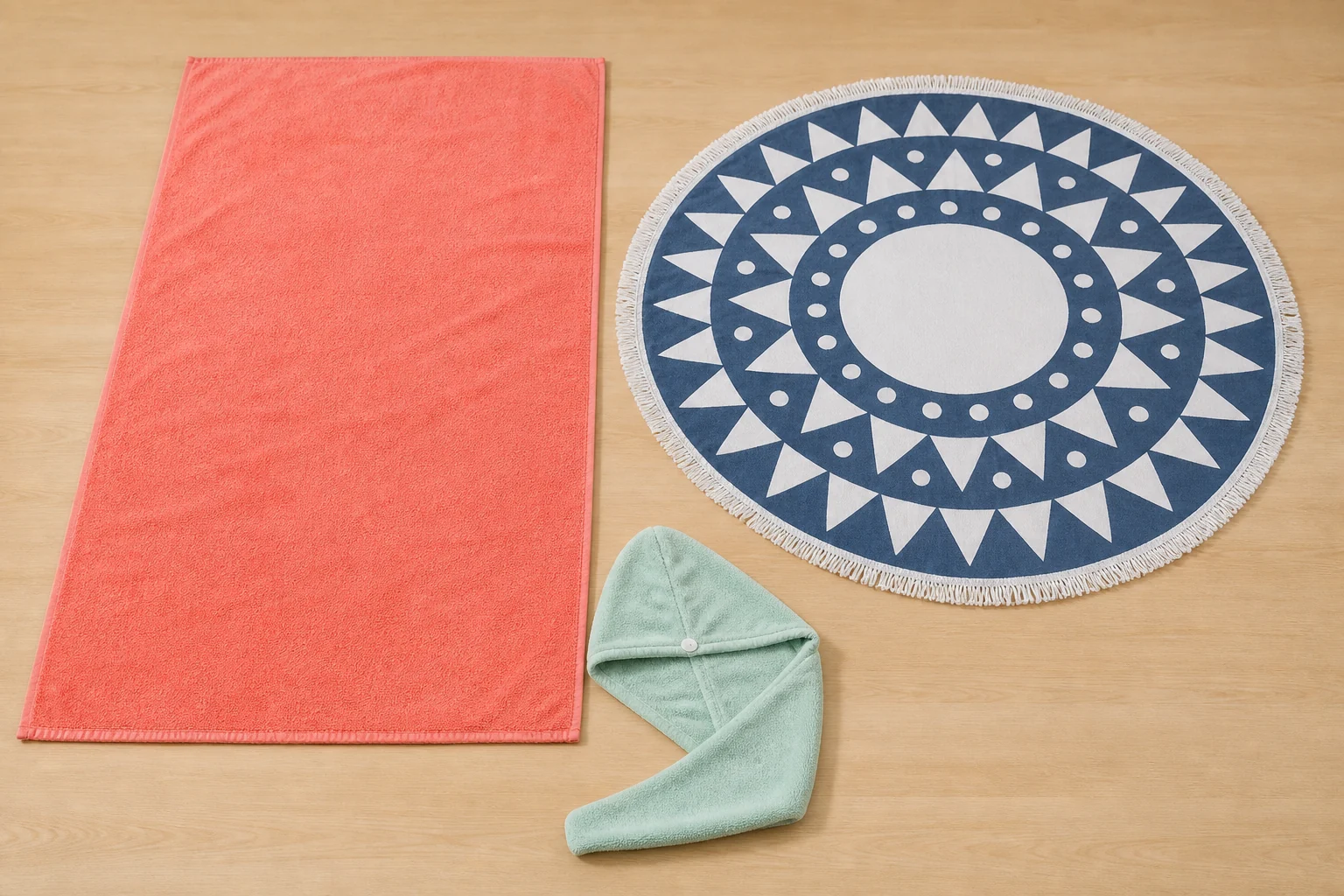
PRODUCT LANDING · CONTROLLED TOWEL PROGRAM
Bath, Beach and Personal-Care Towels Built from a Controlled Buyer Specification
EverBen coordinates wholesale towel programs by separating use, textile construction, finished geometry, decoration, laundering, inspection and pack continuity instead of treating every soft towel as interchangeable.
The family can include rectangular bath towels, flat or terry beach formats and shaped hair-wrap or personal-care articles. A buyer-ready project begins with a SKU map that separates contact, coverage, wet handling, laundering, decoration and channel presentation. Each proposed construction then receives its own coded swatch, complete article drawing, measurement basis, decorated sample, care trial and packed reference. That sequence exposes where two suppliers are pricing unlike fiber wording, pile or weave, borders, closures, artwork work, test scope or carton allocation. It also prevents one attractive showroom sample from silently approving a different production lot. EverBen can coordinate shared colors, artwork files, labels and shipment planning across the family, but technical approval remains attached to each SKU. Buyers should mark every requirement required, offered, alternative or open and assign an owner to evidence and destination decisions. Fiber, GSM, dimensions, claims, MOQ, price and delivery remain project-specific and must be confirmed in the accepted quotation and sample file. No photograph or generic material description proves pickup, drying, lint, wash life, skin suitability, certification or environmental wording for the offered finished article.
01 · PROGRAM MAP
Separate Bath, Beach and Personal-Care Jobs Before Selecting Construction
A shared carton does not make three towel jobs technically equivalent. Define contact, coverage, handling and channel first.
01
Bath and hospitality route
Record guest or retail use, skin contact, coverage, laundering ownership, storage and replacement economics. Do not let a showroom hand-feel replace the operating brief.
02
Beach and resort route
Define sand, wet handling, pack volume, display face, decoration, drying environment and whether the article is terry, flat woven or another approved construction.
03
Hair and personal-care route
Describe the complete shaped article, fastening, hair or skin contact, wet load, wearer range and care method. Review every edge and button interface.
04
Mixed-program control
Use separate SKU specifications and samples while coordinating color, artwork, cartons and shipment. One generic towel line cannot approve unlike products.
02 · TEXTILE SYSTEM
Define Fiber, Yarn, Weave, Pile and Finish as One Construction
Fiber percentage and GSM describe only part of the textile. The physical reference must connect every construction field.
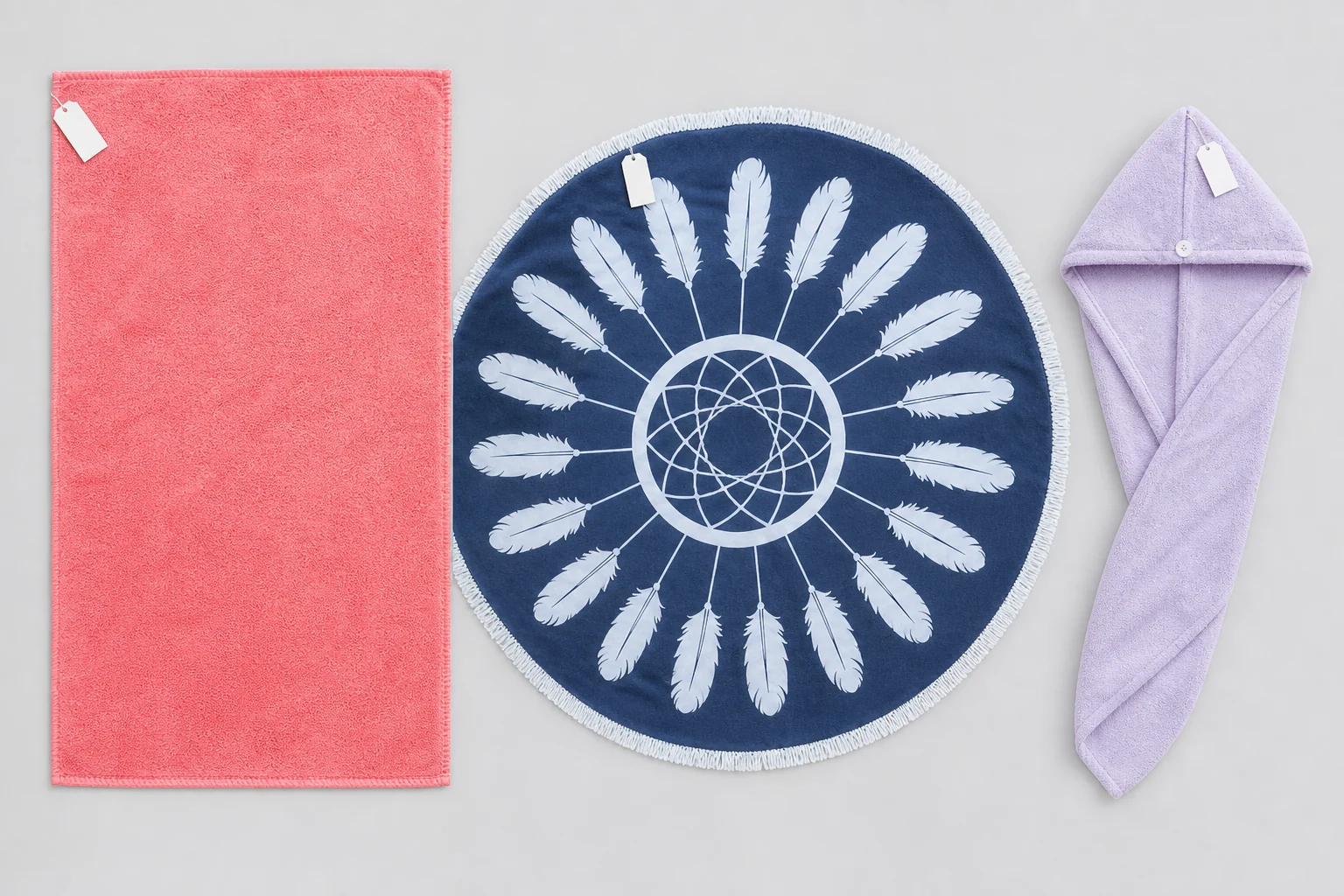
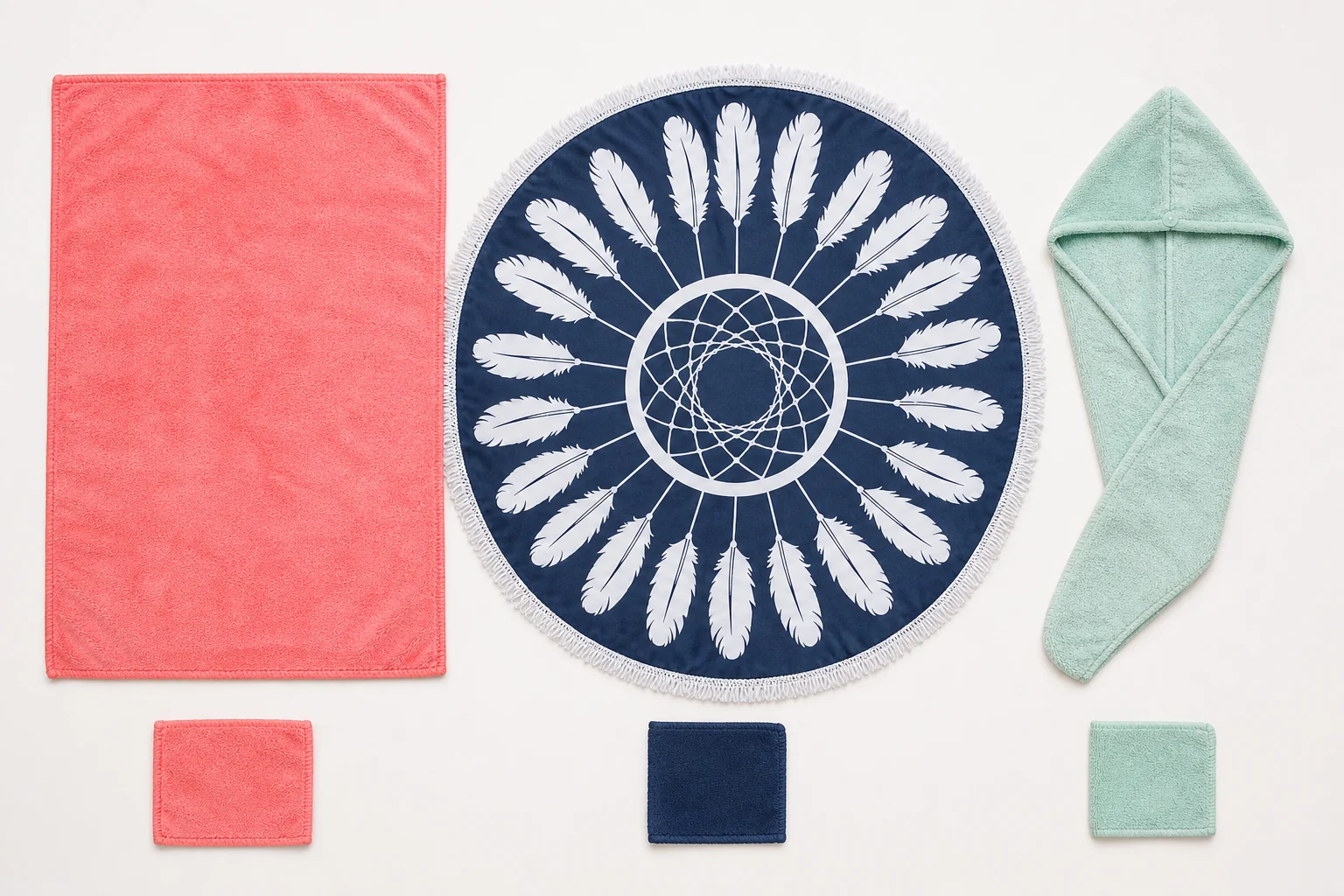
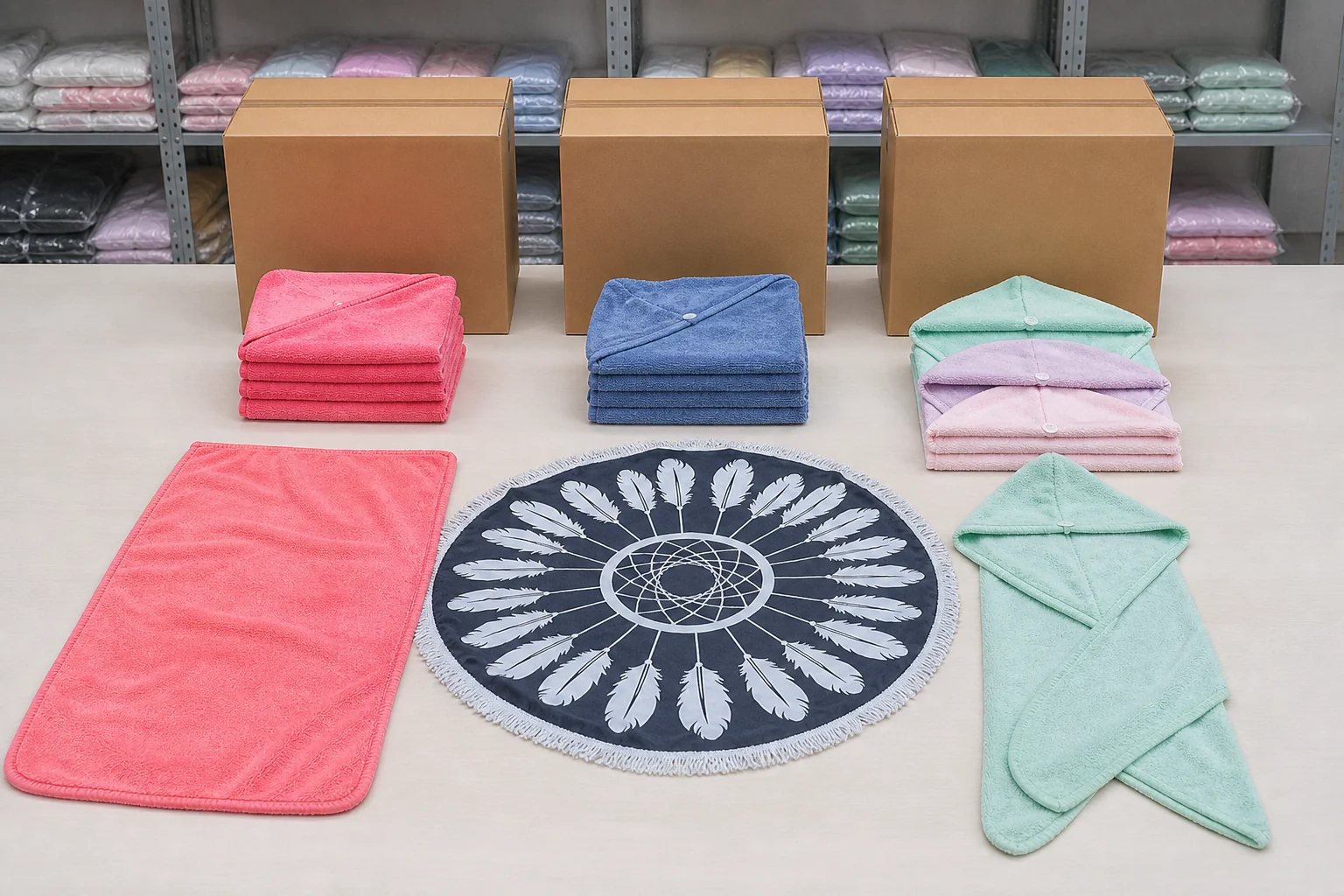
| Entity | Attribute | Buyer record | Approval evidence |
|---|---|---|---|
| Use case | Contact, liquid, motion and cycle | Application card | Buyer-approved operating brief |
| Textile | Fiber, yarn, weave or pile, finish and code | Controlled construction sheet | Coded swatch and applicable document |
| Finished towel | Shape, size, weight basis, edge and closure | Drawing and tolerance | Complete approved sample |
| Care | Wash, rinse, extraction, drying and observations | Trial protocol | Dated before-and-after record |
| Pack | Fold, label, assortment and carton | Packing map | Sealed retained unit |
01
Fiber declaration
State the offered composition and supplier code, then attach documentary evidence where a fiber claim will be published. Do not infer the finished article from a family name.
02
Yarn and filament route
Record the offered yarn, twist or filament description to the available evidence level. Keep unconfirmed technical values marked for project confirmation.
03
Terry, flat or shaped build
Identify pile, ground, face, reverse, border and any shaped panels. A bath towel, printed round towel and hair wrap need different drawings.
04
Finish and first-hand effect
List brushing, softening, shearing or other proposed finish. Verify wash behavior because temporary finish can change touch and pickup.
03 · MEASUREMENT BASIS
Control Finished Dimensions and Weight without Hiding the Method
Comparable values require the same conditioning, washing and measurement basis. Larger or heavier is not automatically better.
01
Finished size
Specify cut or finished dimensions, shape, border and tolerance, plus whether measurement occurs before or after an agreed wash or conditioning step.
02
GSM and unit weight
Record the method, specimen state and tolerance. For shaped articles, unit weight and finished geometry may communicate more clearly than GSM alone.
03
Coverage and pack impact
Relate size and weight to wearer coverage, beach use, laundry load, drying space, shelf footprint and freight instead of ranking one number in isolation.
04
Measurement record
Use calibrated tools, sample identity, date and operator. Retain raw results so a later reorder can be compared to the approved reference.
04 · CONTACT INTEGRITY
Review Hems, Borders, Fringes, Fasteners and Labels on the Complete Article
Perimeters and attachments often create complaints that a center swatch cannot reveal.
01
Hem and corner security
Define stitch route, thread, seam bulk, corner geometry and unacceptable loose ends. Inspect complete corners after the agreed care sequence.
02
Fringe and decorative border
Set length, density, attachment and appearance acceptance where fringes or borders are used. Check tangling and distortion under the intended wash route.
03
Hair-wrap closure
Confirm button, loop, seam, orientation and wearer handling on complete samples. Avoid universal fit or safety claims without the buyer's own evaluation.
04
Label placement
Position labels, care marks and branding so they do not undermine contact comfort or function. Approve content and destination obligations separately.
05 · BRAND EXECUTION
Choose Decoration after the Use Face and Care Route Are Known
Print, dye, embroidery, jacquard and packaging affect hand, appearance, absorbent area and continuity.
01
Artwork feasibility
Test detail, repeat, color count and orientation on the actual textile rather than approving only a smooth digital mockup.
02
Face and reverse expectations
Define which side carries the design, required penetration or reverse appearance and any unprinted contact or drying zones.
03
Embroidery and labels
Control backing, stitch density, position, thread ends and contact. Confirm that decoration remains acceptable after the agreed wash trial.
04
Color reference
Use named physical standards or approved strike-offs with lighting and tolerance notes. Screens are not production color evidence.
06 · CARE VALIDATION
Validate the Exact Towel through the Intended Laundry and Drying Route
Care instructions must follow the product construction and operating environment, not a generic fiber assumption.
01
Cycle definition
Record washer type, load, water, detergent, additives, temperature, agitation, rinse, extraction and drying. Buyer sanitation needs require separate responsible review.
02
Before-and-after observations
Measure dimensions and weight on the agreed basis; inspect shade, hand, lint, loop pull, edge security, decoration and closure condition.
03
Repeated-use relevance
Choose a cycle count that supports the buyer's decision without converting a limited trial into a lifetime promise. Retain samples at agreed gates.
04
Care-label release
Publish only instructions supported by the accepted construction and trial scope. Keep destination language and symbols under buyer approval.
07 · CLAIM BOUNDARY
Translate Soft, Absorbent and Quick Dry into Testable Questions
Marketing adjectives are not self-proving attributes. Each intended statement needs a defined object, method and decision owner.
01
Pickup and absorbency
State the liquid, conditioning, procedure and result needed for the exact article. Do not infer performance from fiber, pile or GSM alone.
02
Drying behavior
Define wet loading, environment, airflow, hanging geometry and endpoint. A comparative trial is more useful than an unconditional quick-dry promise.
03
Lint and shedding
Choose the contacted surface and observation or measurement route. Skin, dark fabric, glass and optical surfaces can require different acceptance.
04
Skin and environmental wording
Treat hypoallergenic, antimicrobial, organic, recycled and similar claims as evidence-dependent. Do not publish them until the applicable chain is verified.
08 · SAMPLE GATES
Approve Swatch, Decorated Article, Care Trial and Packed Unit as Different Gates
One attractive sample cannot answer every construction, use and packing question.
01
Coded textile swatch
Lock fiber wording, construction, color and finish to a supplier code before design work proceeds.
02
Complete undecorated sample
Check shape, dimensions, hems, borders, fringe or closure on a full article; photographs of partial fabric are insufficient.
03
Decorated and washed sample
Review artwork, hand and visible change after the agreed care sequence. Record deviations and approval owner.
04
Packed retained reference
Seal one approved unit with labels, inserts, fold, inner pack and carton allocation so production and reorders have a comparator.
09 · QUALITY CONTROL
Inspect Critical Characteristics from Incoming Textile to Finished Pack
The control plan should connect defects to methods, sampling and disposition rather than repeat broad quality promises.
01
Incoming identity
Verify textile code, shade lot, construction documents and physical reference. Quarantine unexplained substitutions or mixed lots.
02
In-process controls
Check cutting, shape, stitch, border, fringe, closure and decoration at operations where correction is still practical.
03
Finished inspection
Use the approved sample and written tolerances for dimensions, appearance, workmanship, count and any represented functional checks.
04
Nonconformance record
Separate critical, major and minor issues according to the buyer's plan, preserve evidence and authorize rework or release explicitly.
10 · PACK CONTINUITY
Design Folding, Assortment, Labels and Cartons around the Real Channel
Packing protects the approved article and controls assortment; it should not be finalized as an afterthought.
01
Fold and presentation
Define the visible face, fold dimensions, compression limit and recovery check for retail, hospitality or promotional distribution.
02
Inner-pack identity
Record SKU, color, size, count, hygiene or moisture protection needs and barcode responsibility without inventing destination marks.
03
Carton assortment
Map color and size ratios, carton count, gross/net weight method and destination allocation. Use a packing sample for approval.
04
Change notice
Require notice before textile, finish, stitch, decoration, label, bag, carton or packing-sequence changes. Reorders reference the retained pack.
11 · COMPARABLE QUOTE
Normalize Development, Evidence, Packing and Delivery Scope before Ranking Price
A lower quotation can omit sample gates, testing, labels, inspection or packing that another supplier includes.
| Field | Supplier response | Buyer decision |
|---|---|---|
| Construction | Required, offered, alternative or open | Confirm coded swatch and complete article |
| Measurement | Size, weight, basis and tolerance | Align method before comparison |
| Decoration | Process, artwork, face and color reference | Approve production-scale strike-off |
| Evidence | Object, method, result, date and scope | Classify applicable, informative or gap |
| Commercial scope | Samples, testing, inspection, labels and packing | Normalize before ranking total |
Connect every towel statement to the exact offered SKU
Trace the relationship through construction code, complete sample, method, result, date, destination and responsible approval owner.
Keep background guidance separate from product evidence
A general GSM or care guide can improve questions without proving the offered bath, beach or personal-care towel.
01
Required, offered, alternative, open
Make every supplier mark the status of material, size, decoration, care evidence and pack fields. Resolve open items before commercial comparison.
02
Included development
The quotation must enumerate coded swatches, strike-offs, complete articles, care evaluations, documentary records and archived controls.
03
Inspection and release
State factory checks, buyer or third-party inspection, documentation and release authority. Do not assume one supplier's price contains another's controls.
04
Commercial variables
MOQ, price and delivery depend on accepted construction, decoration, evidence, quantity, packing and destination; confirm them only in the project quotation.
12 · REORDER CONTROL
Preserve the Approved Product Identity across Production and Reorders
Continuity depends on records that connect the buyer's language to physical references and change control.
01
Golden sample file
Keep approved complete samples, coded swatches, artwork, dimensions, care trial and packing record under one revision.
02
Lot and shade continuity
Define identification and comparison across lots without promising perfect visual identity. Record acceptable evaluation conditions.
03
Reorder comparison
Compare new material, finished article and packed unit with retained references before release. Investigate unexplained drift.
04
Ownership and archive
Name who controls revisions, approvals, samples, reports and disposal dates so project history remains usable.
Limits of the towel program description
Absorbency, drying speed, lint behavior, skin contact, fiber declarations and environmental language must be evaluated for the accepted article. Certification, care endurance, order minimums, price and dispatch timing are also project-specific; every representation stays connected to its named revision, destination and supporting record.
Buyer FAQ
Questions to close before a towel release
Is GSM enough to specify a towel?
No. GSM must be read with fiber, yarn, weave or pile, finish, size, conditioning, edges, use and care route.
Can one towel specification cover bath, beach and hair-wrap products?
No. Coordinate commercial elements, but keep separate SKU drawings, constructions, samples and acceptance criteria.
Can EverBen promise absorbency or quick drying from a photo?
No. The claim needs an exact article, conditioning, method, conditions and approved result.
How should buyers approve decoration?
Approve artwork on the actual production construction, then review the complete decorated article after the agreed care trial.
What should be retained for reorders?
Keep coded swatches, complete samples, artwork, measurements, care evidence, labels and a sealed packed reference.
Are MOQ, price and delivery fixed on this page?
No. They depend on the accepted product scope, quantity, decoration, evidence, packing and destination.
Procurement handoff
Turn the Towel Family into a Controlled RFQ
Send applications, SKU list, construction preferences, dimensions, decoration, laundry route, evidence questions, quantity, packing and destination. Include the intended sales or operating channel, sample owners, acceptance gates and any claims the buyer expects to publish. Unconfirmed fields will remain explicitly open and will not be converted into assumptions during quotation.