Independent B2B guide: EVA/PEVA film, construction, print, pack and evidence decisions

Buyer education · EVA and PEVA rainwear sourcing

EVA & PEVA Rainwear Buying Guide: Film, Construction, Packing and Evidence

Use this guide to replace vague material names and catalogue photos with a decision sequence: identify the film, choose architecture, isolate joint risk, test the wearer system, approve print and fold contact, challenge the pack and retain evidence for bulk release.

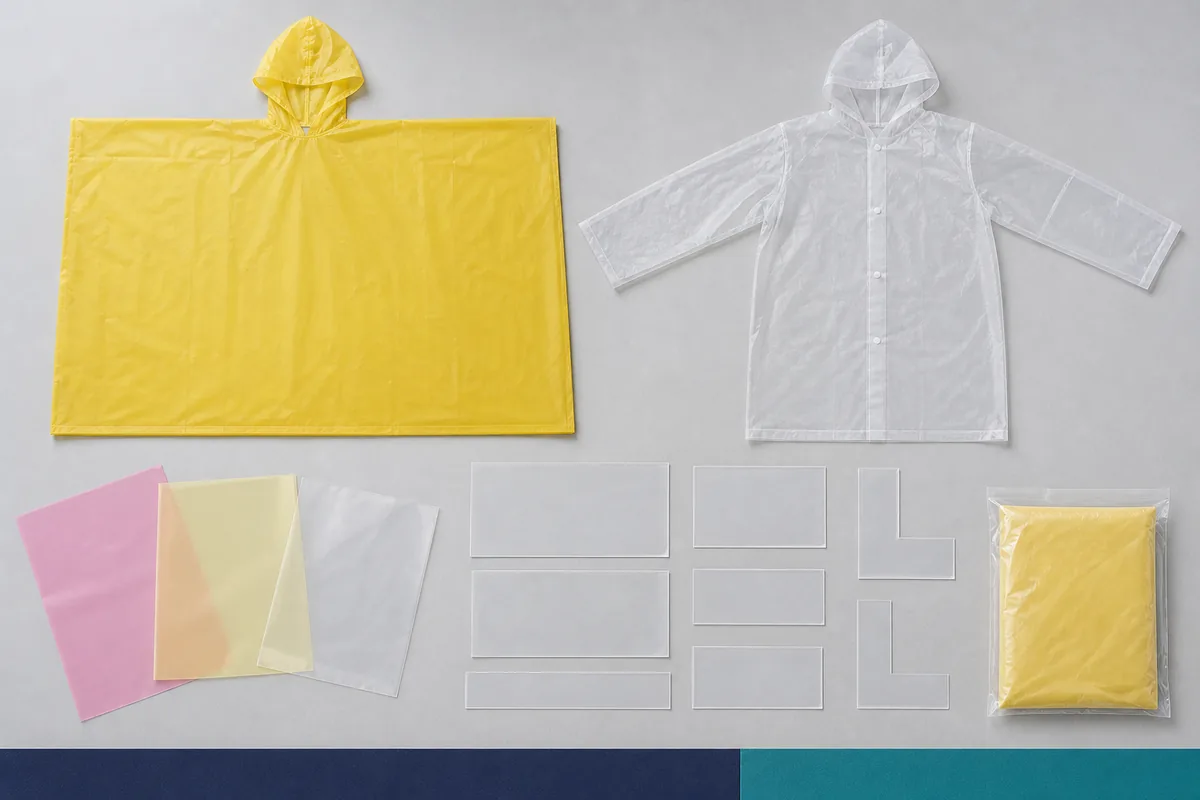
Yellow cape, translucent jacket, film specimens and construction coupons for EVA or PEVA sourcing review
Follow the decision sequenceConnect material identity, construction, garment, artwork and packing evidence before comparing bulk offers.

1. Start by Asking What the EVA or PEVA Material Name Actually Identifies

The first sourcing mistake is treating a broad material name as a finished specification. The name must lead to a physical specimen and a controlled comparison.

Commercial names can hide different film objects

EVA, PEVA and related trade wording may be used differently by suppliers. Ask which film, source code, surface, color and nominal dimension the quotation describes. If a supplier will not disclose formulation detail, the buyer still needs a stable commercial identity and a substitution rule that protects the approved sample.

Do not assume that two quotes using the same abbreviation describe the same hand, haze, blocking, print response or weld behavior.

Every value needs a specimen and unit

A number can refer to loose-film thickness, area mass, finished garment weight or packed-unit weight. Write the specimen next to the value and state the nominal target, tolerance and agreed method. This prevents a low garment weight from being mistaken for a thin film or a nominal film value from being treated as a complete product description.

The specimen definition should remain visible from quotation through incoming material review.

Broad environmental and safety claims need exact evidence

Words such as eco-friendly, biodegradable, non-toxic and child-safe cannot be inherited from a competitor page or generic material description. The intended market, exact SKU, claim wording and current evidence must be reviewed. When that proof is not available, keep the public language conditional and concentrate on inspectable product decisions.

A company certificate is not automatic proof for every film, print and finished garment.

Check whether your material line describes an object.

Send the wording from the current quote and the sample label. We will expose the missing identity fields.

2. Compare Film by Dimension, Hand, Haze and Surface—Not by One Adjective

Useful comparison combines measurements with physical references. Buyers should agree how samples are conditioned, viewed, handled and packed before deciding which differences matter.

Thickness is a controlled dimension, not a quality grade

Specify where and how loose film is measured, which zones are excluded and how many lot observations the project needs. Thickness can affect drape, fold volume, process window and component reinforcement, but it cannot by itself predict durability, softness or suitability for a wearer task.

Compare the finished architecture after the film dimension is understood because geometry can amplify or reduce the effect.

Hand and flex require shared conditioning

Condition candidate and reference film together, then bend, fold, unfold and compare recovery under a recorded environment. This reduces disagreements caused by one warm loose swatch being compared with another sample that has been compressed or stored cold.

Record the accepted physical reference and the conditions; do not publish a universal softness score.

Haze, opacity and surface need a viewing method

Review clear, translucent or colored film over agreed light and dark backings under useful illumination. Observe tint, show-through, surface marks, gloss or matte appearance and whether backing changes print readability. Screen photos cannot replace this decision because camera exposure and display settings alter transparency.

Retain the approved sample so the bulk lot can be judged against the same object.

3. Select Poncho, Jacket, Long Coat or Apron from Coverage and Movement

Product architecture is a cost and risk driver. A wide poncho and a sleeved coat create different openings, joints, size routes, print areas and pack volumes.

A cape poncho prioritizes fast issue and broad upper coverage

A wide cape can simplify distribution and layer accommodation, but side openness, hand access, wind lift, hood stability and hem movement must be reviewed. Define front and back length, side closure route and whether a backpack, seat or equipment changes the intended coverage.

Do not use one generic poncho specification for events, travel and cycling without comparing their different exposure and control needs.

A sleeved jacket trades openness for controlled arm movement

Separate sleeves and a front closure can support reach and access, while adding sleeve-root, cuff, snap and pocket interfaces. Size grading and layering become more important. Test normal reaching, sitting and donning with the clothing worn underneath.

The visible sample is a starting geometry; exact dimensions and components remain controlled project decisions.

A long coat or apron needs its own claim boundary

Long coats add lower coverage but may limit stride and increase fold size. Aprons protect only the covered front area and must not be presented as full rainwear or specialized chemical, medical or food-contact protection without evidence. Define the actual task, attachment points, edge shape and unprotected zones.

Legacy decorative artwork should never be reused unless the buyer owns and authorizes it.

Choose architecture from the wearer task.

Tell us what must be covered, what must move and how the item is issued. We will compare the viable routes.

4. Build a Sample Challenge that Separates Material, Joint and Component Risk

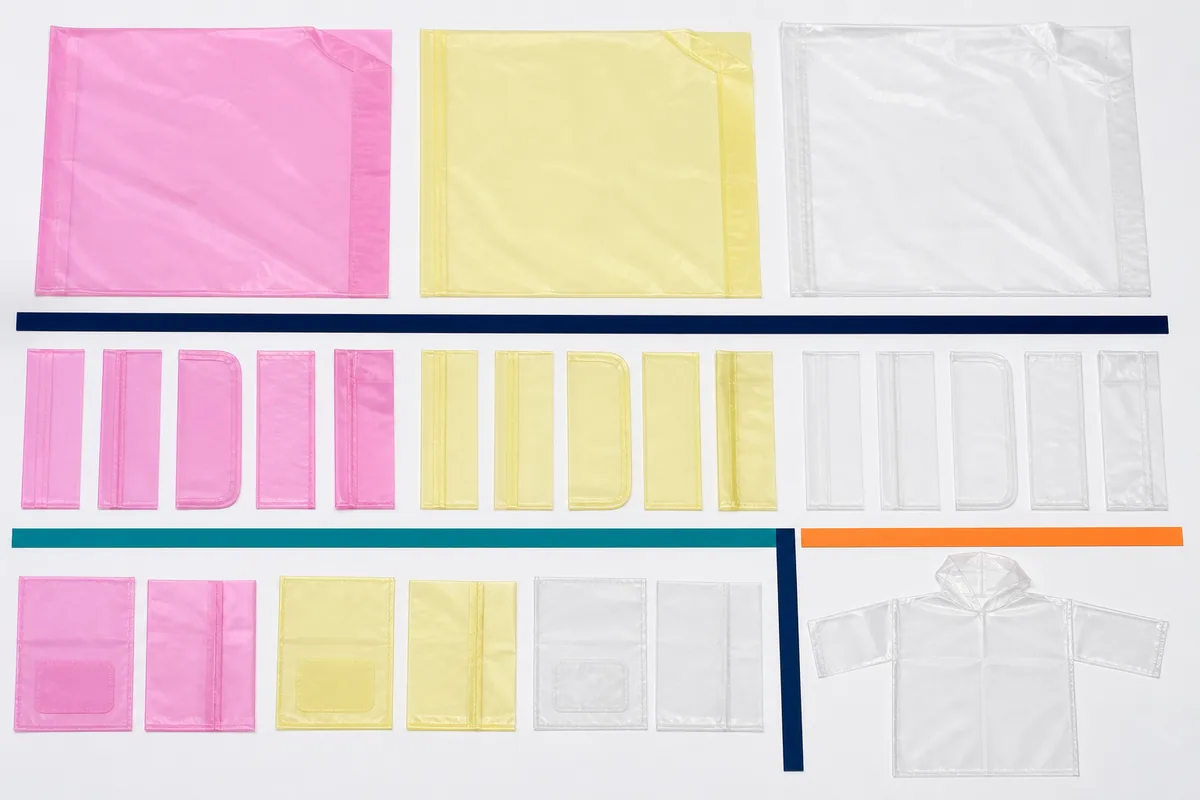
A complete garment can hide which part of the system caused a problem. Small labeled coupons isolate the decisions before the integrated wearer trial.

EVA or PEVA film, welded joint and snap-stack coupons arranged for a buyer sample challenge
Use separate specimens to find material, weld, corner and closure risks before committing to a complete garment sample.

Begin with loose-film and fold objects

Keep an identified loose reference, a folded strip and any conditioned comparison pieces. Observe dimension, visual appearance, hand, whitening, recovery and surface contact under the project conditions. The purpose is to decide whether the proposed material deserves construction trials.

A successful loose-film review does not establish weld, snap or finished-garment behavior.

Use different coupons for straight welds, corners and edges

Straight overlaps establish a baseline, while corners and curves reveal gathering, layer stack and process variation. Record film orientation, overlap, represented location and disposition. Retain useful failed examples when they clarify a workmanship boundary.

Do not convert an internal coupon trial into a public certification statement.

Treat the snap and reinforcement patch as one stack

Identify the snap, patch material, dimensions, edge distance and installation direction. Observe local whitening, distortion, tearing or pull-through after the agreed operation sequence. Then check the finished location during donning and movement.

A component with a similar appearance can require renewed evidence if its construction changes.

5. Evaluate Openings and Fit with the Real Wearer System

Thin-film rainwear often fails the user experience at the face opening, neck, sides, cuffs or front closure rather than the center of a panel.

Map rain and runoff around the hood and front

Trace water from the hood edge through the neckline, front overlap and closure termination. Check crown volume, face opening, side vision and head turning over normal caps or helmets. Record the adjustment route and any small components that require destination-market review.

A deep-looking hood can still pull away or obstruct vision during movement.

Use body, garment and layer dimensions correctly

State whether the chart describes the body or finished product, and record the clothing or equipment underneath. Broad-fit items still need a target wearer range. Add product dimensions that control reach, opening, length and hood space with suitable tolerances.

Avoid universal-size language unless the claimed range has actually been evaluated.

Test donning, reach, walking and sitting from the real pack

A loose sample may be easier to open than a compressed unit. Start with the proposed individual pack, then observe orientation, unfolding, closure operation, arm movement, hem behavior and removal. Add only the movements relevant to the project.

Keep observations and changes by revision so a fit fix does not create a new fold or joint risk.

Move the sample before approving the size chart.

Share the layer system and required movements. We will create a short wearer trial.

7. Use the Packed Sample to Judge Folding, Blocking and Distribution

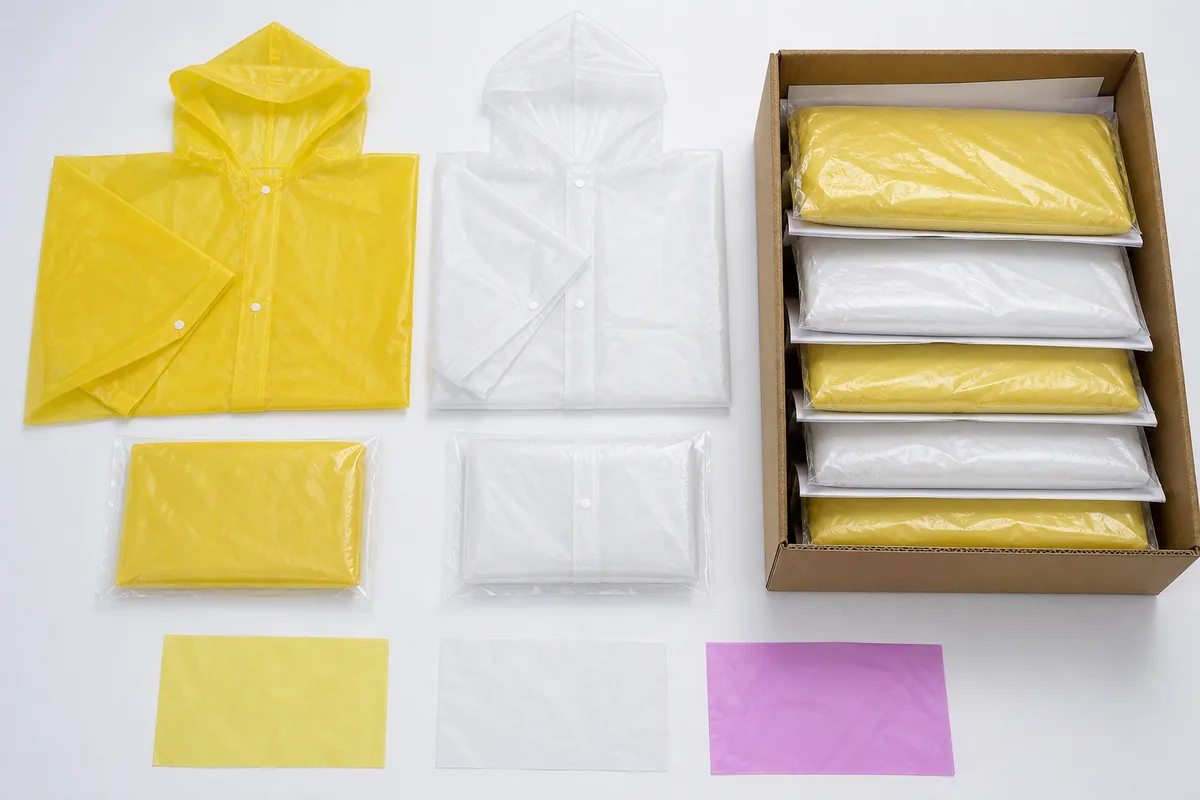
Packing can change the product that the user receives. Fold sequence, pressure, temperature, pouch construction and carton density belong in the approval route.

Yellow and clear EVA or PEVA rainwear shown flat, folded, bagged with paper separators and placed in a kraft carton
Compare fold contact, bag fit, paper separation and carton pressure using the approved garment and packing sequence.

Freeze a repeatable fold map

Define where the hood, sleeves, closure, printed face and components sit in the folded unit. Avoid hard stacks and vulnerable contact. If several sizes share one pack, confirm that each can follow the same route without excessive compression.

Tie the fold instruction to the approved garment and pack revision.

Define acceptable release after pressure and temperature

Review whether film surfaces separate without damage or unreasonable delay after the proposed packed challenge. Observe blocking, whitening, crease recovery and whether users can find and open the garment. Record the exact pack, pressure, time and temperature.

The result applies to that project configuration, not every possible warehouse or transport condition.

Connect individual pack to carton and allocation

Specify pouch or bag, closure, insert, language and the distribution task. Then define carton count, orientation, mixed-SKU rules and destination splits. A total order may contain many color, artwork, language and destination combinations that affect supply lots and inspection.

Ask suppliers to quote the actual split rather than a convenient undivided total.

Inspect the product the user actually opens.

Send the fold, individual pack and carton idea. We will identify the blocking and allocation decisions.

8. Use Four Evidence Gates before Bulk Release

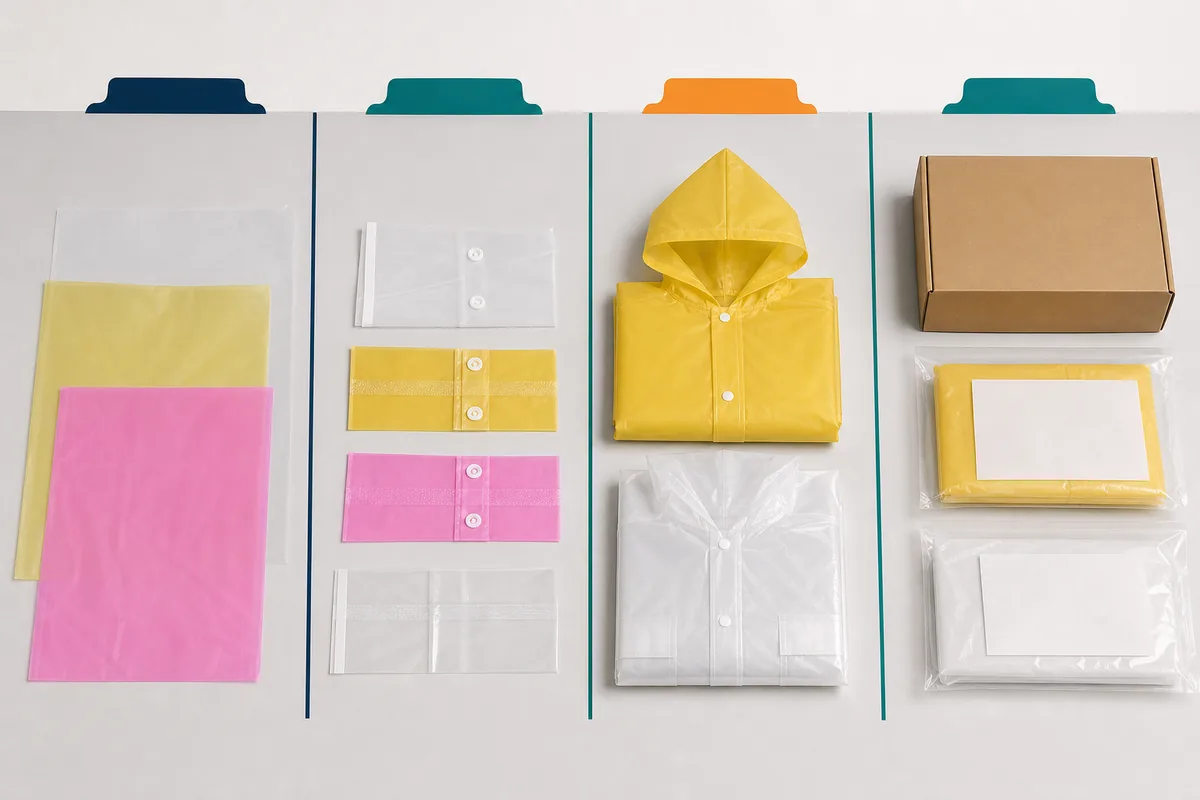
The most reliable supplier conversation follows physical objects: identified material, construction coupons, integrated garment and packed bulk reference.

EVA or PEVA material specimen, construction coupons, garment sample and packed reference arranged in approval order
Each approval object answers a different question and carries a revision, decision owner and reason to reopen the gate.

Gate one: identified material

Retain the accepted film with source or controlled code, dimension definition, color, surface and conditioned observations. Add a rule for substitutions and identify which claims still require project evidence.

The supplier data sheet supports this gate but does not replace the accepted physical reference.

Gate two and three: coupons then integrated garment

Approve straight welds, difficult turns, edges and snap stacks before relying on the complete sample. Then challenge fit, openings, movement, artwork and component locations on the finished garment.

Coupon and garment records should use the same material and component identities.

Gate four: packed reference and sampled bulk lot

Seal the approved fold, individual pack, carton plan and allocation logic with the pre-production set. Bulk inspection then compares lot identity, workmanship, print, pack, quantity and carton marks using the agreed risk-based sampling.

Inspection records what was checked; it does not prove every unit or future order.

Evidence order: material → coupon → garment → pack → sampled bulk lot

Moving forward means the earlier object remains identified. A change in source, formulation, process, component, artwork or packing returns the project to the gate affected by that change.

The reorder question

Which object changed, which buyer risk reopened, and which evidence must be repeated before release?

9. Ask Supplier Questions that Reveal Assumptions before Quotation

Good questions do not demand confident promises. They require the supplier to name the proposed object, open decision and evidence route.

Ask what is fixed and what is provisional

Request the exact film, thickness definition, color, surface, construction, components, print route and pack basis used for the quotation. Ask which fields will be finalized only after sampling and which substitutions require written approval.

This separates a comparable bid from a price based on silent assumptions.

Ask for evidence scope rather than badges

For each material, performance, environmental or compliance claim, ask which current document, SKU, color and test scope supports it. Keep company credentials separate from supplier qualification and finished-product evidence.

A certificate logo on a website is not a substitute for current project-specific proof.

Ask how quantity splits change MOQ and timing

Give the real matrix of architecture, size, color, artwork, pack language and destination. Ask the supplier to identify separate material or production minimums, sample dependencies and the critical path. Do not rely on a universal MOQ or lead time copied from another product.

Commercial values are confirmed after the actual combination is reviewed.

Use questions that force hidden assumptions into the open.

Send the current supplier replies. We will sort them into confirmed facts, open decisions and unsupported promises.

10. Convert the Decisions into a Quote-Ready EVA/PEVA RFQ

The final RFQ should be concise enough to use and complete enough to expose material, construction, packing and evidence costs.

Product and wearer block

Name architecture, use, wearer range, layers and movement. Then list each size-color-artwork quantity split beside its authorized reference and mandatory visual details. If multiple architectures remain open, request separate options rather than one blended price.

This block controls what the supplier is actually pricing.

Material and construction block

State the EVA/PEVA identity available, nominal thickness definition, appearance reference, weld families, reinforcement, snaps, edges and any project conditioning. Mark unknown fields as sample decisions and request labeled coupons.

Do not fill gaps with competitor values or broad claims.

Artwork, pack and evidence block

Provide authorized artwork revision, print area, fold exclusions, individual pack, carton objective, destination split, target date and required inspection or third-party evidence. Ask the supplier to return assumptions, MOQ and timing against this exact combination.

The comparison should show confirmed facts, proposed options, open gates and optional evidence costs.

Frequently Asked EVA & PEVA Sourcing Questions

These answers define a responsible decision route. Exact commercial and technical values are confirmed for the project.

What is the biggest mistake when comparing EVA or PEVA rainwear quotes?

Treating the material abbreviation as a complete specification. Compare the exact film identity, specimen, dimension, appearance reference, architecture, joints, components, print, packing and evidence route.

Should buyers request a complete garment sample first?

A complete sample is important, but labeled film and construction coupons can expose material, weld, corner and snap risks earlier and make the integrated garment trial more meaningful.

Does greater thickness always mean better rainwear?

No. Thickness can influence drape, fold volume and process response, but suitability also depends on formulation, architecture, joints, components, wearer task and packing.

Can supplier certificates prove every EVA or PEVA product claim?

No. Company credentials, supplier qualification, material documents and SKU-specific finished-product evidence are separate. Check current scope, exact claim wording and destination requirements.

What protects an EVA or PEVA reorder?

Preserve the identified film specimen, accepted joint examples, sealed pre-production unit, component register, artwork revision, packed reference, carton configuration, lot-inspection history and a written rule for reviewing change.

Ready to convert the guide into a product brief?

Open the dedicated product page and send the wearer, film, architecture, print, pack and destination.

Build the Product RFQ
CallWhatsApp