

PRODUCT LANDING · SPECIFICATION CONTROL
PVC Shower Curtain Manufacturer for Controlled Wholesale Programs
Build a buyer-owned PVC shower-curtain specification before comparing price, samples or market claims.
For importers, hospitality distributors and private-label programs, the largest risk is approving an attractive film while leaving the finished curtain, hanging interface, decoration, pack and evidence undefined. This page turns those variables into a release sequence.
RFQ checkpoint 01
Define the sales object before discussing film
A liner, decorative outer curtain, hotel replacement item and packaged hook set may share a tariff description while requiring different construction records. Name the finished object, its buyer and its use boundary first.


01
Liner or outer curtain
State whether the article hangs inside the tub as the water barrier, outside as decoration, or works as a coordinated pair. That decision changes the face presentation, lower-edge behavior, packing story and the evidence a buyer expects. Do not let a supplier infer the role from a photograph.
02
Project or retail unit
A hotel replacement curtain may ship in a protective bulk pack, while a private-label retail item needs artwork, folding, barcode location and shelf presentation. Record the commercial unit separately from the shipping carton so quotations do not hide pack conversion work.
03
Bathroom interface
Describe rod position, opening width, tub or tray geometry and the planned hooks or rings. The curtain is accepted as a hanging system, not as a flat rectangle. A usable brief identifies the surfaces and hardware that the finished article must meet.
04
Destination and claim set
List the destination market and every phrase intended for packaging or sales copy. Material identity, care wording and performance statements may trigger different evidence requests. A supplier should quote the requested claim file rather than assume that a familiar trade label is sufficient.
RFQ checkpoint 02
Write a supplier-declared PVC material identity
“Vinyl” is a family description, not a release specification. The buyer file should separate the declared polymer construction from colour, surface, gauge and claims.
| Entity | Attribute | Value status | Acceptance record |
|---|---|---|---|
| Flexible film | Declaration, colour, transparency, surface, gauge method | Required / proposed / open | Coded film reference and supplier declaration |
| Finished curtain | Width, length, edges, squareness | Buyer drawing plus accepted tolerance | Measured complete sample |
| Top interface | Header, openings, spacing, eyelet or hole | SKU and hardware specific | Drawing and documented hang trial |
| Decoration | Artwork revision, face, scale, placement | Brand-controlled | Approved file and full-size printed article |
| Pack | Fold map, unit pack, insert, labels, carton | Channel specific | Sealed unit and carton specification |
Measurement ownership belongs in the release file
A value is not controlled until its datum, method and status are named.
Keep proposed and accepted values visibly separate
This prevents a supplier quotation assumption from becoming an accidental production approval.
01
Declaration scope
Ask the supplier to identify the represented film and the source of that declaration. Keep the answer attached to a coded material sample and finished curtain. A generic statement from another thickness, colour or factory run cannot silently travel with the order.
02
Colour and transparency
Define clear, translucent, frosted, pearl or opaque with an approved physical reference and viewing condition. Words alone are interpreted differently under bathroom lighting. Record both the visual target and any permitted lot-to-lot boundary.
03
Surface and emboss
Name the intended smooth or embossed face, which side carries the texture and how it should look after folding. Emboss can influence appearance, print presentation and cleaning; it should not be treated as a decorative afterthought.
04
Claim ownership
Separate buyer-required statements from supplier proposals. If packaging will mention composition, odour, restricted substances or another market-facing attribute, identify who supplies the wording and which current record supports the exact finished SKU.
RFQ checkpoint 03
Connect gauge and mass to hanging behavior
A nominal thickness does not explain how a converted curtain will unfold, drape or pull at the top edge. Define the measurement and then evaluate the complete article.
01
Measurement method
Specify whether gauge is checked on the plain film, away from emboss peaks, or by another agreed method. Record instrument, locations and conditioning. Without a common method, two suppliers may report similar numbers for visibly different materials.
02
Finished mass
Use finished-piece mass as a companion control when it adds value, but never as a substitute for dimensions and construction. Hooks, headers, weights and packaging can change the number. The comparison must state exactly what was weighed.
03
Drape trial
Hang a coded full-size sample on the intended or representative hardware. Observe opening, overlap, lower-edge movement and recovery after unpacking. A film swatch can help with touch and colour, but it cannot close this gate.
04
Trade-off record
More material is not automatically better. A different gauge may change cost, fold memory, pack volume and top-edge stress. Record the buyer priority and require suppliers to declare any proposed departure instead of optimizing one number in isolation.
RFQ checkpoint 04
Dimension the finished curtain with named datum points
Finished width and length need a drawing, measurement locations and a clear status. Supplier assumptions about hems or openings can otherwise change usable coverage.
01
Finished width
Define the left and right measurement boundaries and whether side folds or edge treatments are included. State the condition in which the curtain is laid out. A catalogue size without datum points cannot support an objective incoming check.
02
Finished length
Name the upper and lower datum, including how the top header and bottom edge are treated. Relate the dimension to the planned rod and wet area while avoiding an unsupported universal installation recommendation.
03
Squareness and edge form
Record the acceptable relationship between side and lower edges, plus any corner shape or sealed boundary. The approval sample should show the intended edge appearance so inspection is not reduced to a single length reading.
04
Tolerance ownership
Mark each tolerance as buyer-required, supplier-proposed or still open. Review how the proposal affects coverage, hook alignment and packaging. Only accepted values enter the released specification; quotation defaults remain visible as departures.
RFQ checkpoint 05
Engineer the header, openings and hook interface together
Top-edge complaints often begin with a mismatch among reinforcement, hole geometry, spacing and the buyer’s hardware. Treat these attributes as one interface.
01
Header construction
Describe whether the top edge is folded, welded, reinforced with another strip or converted by another agreed method. Approve the visible form and feel on the finished curtain; do not infer strength from the label used for the process.
02
Opening count and spacing
Issue a drawing with count, center positions, edge offsets and permitted variation. The total width alone does not guarantee alignment. Retain a measured top-edge reference so repeat lots can be compared efficiently.
03
Hole or eyelet detail
Define opening shape, size, finish and any fitted component. If metal or another insert is used, identify it as a separate entity with its own declaration and appearance boundary. Avoid unsupported corrosion or durability promises.
04
Hardware trial
Test the represented hooks or rings through every opening and hang the complete sample. Check insertion, movement and local distortion. Record the actual hardware code, because a result with one hook design may not predict another.
RFQ checkpoint 06
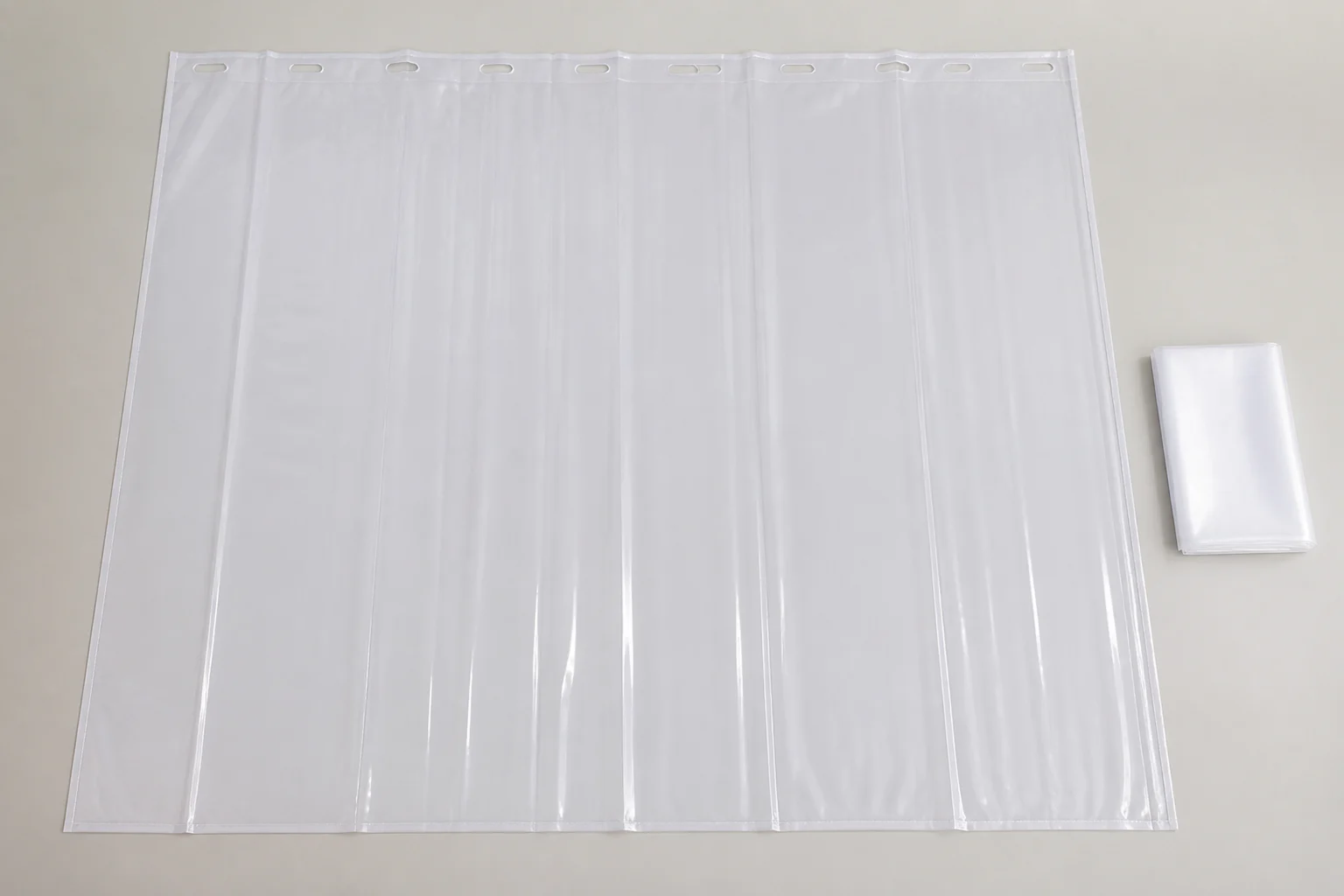
Control colour, print and emboss as production assets
Decorative approval needs more than an attractive digital image. Separate colour references, artwork ownership, print placement and the effect of folds.

01
Colour standard
Use a physical or named colour reference and record the viewing condition. Transparent and translucent films can shift with background and light, so the approval method should match the intended presentation rather than a phone-screen impression.
02
Artwork revision
Give every printable file a revision, dimensions and ownership status. Confirm which face receives the print, orientation from the bathroom side and any no-print zone near seams or openings. Superseded artwork must not remain in the production packet.
03
Register and scale
Approve placement against the finished curtain, not only a cropped proof. Check motif scale, repeat, margins and orientation after conversion. A signed artwork file and a coded printed sample close different risks and both should be retained.
04
Fold presentation
Review the printed or embossed face after the proposed retail fold and a defined conditioning period. Record unacceptable transfer, blocking, distortion or visible fold memory as observations on that sample, not as universal material claims.
RFQ checkpoint 07
Evaluate odour and appearance after packing
The buyer receives an article that has been folded, enclosed and transported. Packed condition is therefore a separate approval gate from fresh film.
Buyer-controlled field
Vendor-declared option
Owner and deadline needed
Revision-linked reference
01
Conditioning protocol
Define how long the sample remains in the intended pack, the approximate storage condition and when it is opened for review. Uncontrolled impressions taken at different times cannot be compared across suppliers.
02
Observation record
Use neutral, descriptive observations and identify the reviewers, timing and sample code. Avoid converting a subjective note into a chemical conclusion. If a claim needs testing, request the appropriate scoped evidence separately.
03
Appearance on opening
Inspect blocking, fold set, print transfer, surface marks and ease of unfolding. Photograph the complete item and relevant detail without treating the image as proof of material composition or service life.
04
Corrective path
If packed condition is unacceptable, change one defined variable at a time—film, conversion, airing, fold map or pack—then repeat the same protocol. A controlled comparison is more useful than adding an unverified treatment.
RFQ checkpoint 08
Define care wording and service boundaries
Water shedding, wiping and replacement behavior depend on the complete article, use setting and care method. Public claims must stay within what the represented SKU supports.
01
Care instruction owner
Decide who supplies and approves care wording for the destination. Review symbols and text against the declared material and decoration. Do not copy instructions from a textile curtain or a different film construction.
02
Wet-use observation
Hang the sample in a controlled representative setup and observe coverage, lower-edge position and drainage. Record the configuration and outcome without presenting the trial as a universal waterproof certification.
03
Cleaning compatibility
Ask for proposed cleaning boundaries and verify them on a coded specimen when they matter to the program. Surface, print and fitted components may react differently; one generic “easy clean” phrase is not an acceptance method.
04
Replacement trigger
For hospitality or project programs, define visible conditions that trigger removal or review. This gives operators an actionable rule while avoiding invented lifetime promises that ignore use frequency, care and environment.
RFQ checkpoint 09
Map each market claim to scoped evidence
A report is useful only when its specimen, method, date, destination and claimed meaning fit the finished product being sold.
01
Claim inventory
Copy every intended package, listing and buyer-specification statement into a claim register. Plain composition wording, restricted-substance requirements and performance language are different claims and may need different records.
02
Specimen match
Check whether the evidence represents the same formulation, colour, thickness, print and finished article. A document for raw film or another SKU may inform risk review but cannot automatically approve the current curtain.
03
Method and limit
Record the cited method, measured item, result format and the requirement being evaluated. Avoid broad labels such as “tested” or “compliant” when the underlying scope is narrower.
04
Change trigger
Reopen the affected evidence gate after a change to source, formulation, gauge, colour, print, component, claim or destination. The change log should identify what remains valid and what needs renewed confirmation.
RFQ checkpoint 10
Inspect conversion on the complete hanging article
Film acceptance does not close cutting, sealing, opening, print or packing risks. Build a finished-product checklist around visible and measurable outputs.
01
Identity and count
Verify SKU, colour, artwork revision, accessory count and pack identity before detailed inspection. Mixing two visually similar variants can make later measurements meaningless.
02
Geometry and openings
Measure finished dimensions at the named datum points, then check opening count, spacing and edge offsets. Record actual values and the applicable accepted limit rather than a simple pass label.
03
Surface and edges
Review the full face under an agreed condition for unintended marks, print issues, sealing irregularity and edge appearance. Define defect language with reference examples so inspectors do not improvise severity.
04
Functional assembly
Fit the represented hardware and hang selected pieces. This check exposes interference or distortion that may not be visible on a table. Keep the setup and sampling plan in the inspection record.
RFQ checkpoint 11
Design folding, unit packing and cartons as one system
Packing protects the approved curtain and creates the first buyer experience. Fold geometry, insert placement and carton loading should be released with the product.
Buyer-controlled field
Vendor-declared option
Owner and deadline needed
Revision-linked reference
01
Fold map
Specify the fold sequence or approve a marked sample. The map affects package dimensions, opening experience and visible crease location. A verbal instruction is difficult to reproduce across repeat orders.
02
Unit pack
Define bag or box construction, closure, ventilation decisions, insert position, label content and barcode responsibility. Material names or environmental claims on packaging remain subject to the same evidence discipline as the curtain.
03
Carton configuration
Record units per carton, orientation, dividers if any, markings and gross-weight reporting. Validate the proposal against handling and warehouse needs rather than selecting the smallest carton by default.
04
Packed reference
Retain a sealed approved unit and carton specification with the product revision. On repeat orders, compare presentation, count, marks and any pack-related surface change against that controlled reference.
RFQ checkpoint 12
Normalize quotations and release the accepted baseline
Price comparison is meaningful only after suppliers expose included work, proposed deviations and open decisions against the same requirement revision.
01
Common RFQ revision
Issue one dated brief containing material identity, finished drawing, openings, decoration, packing, evidence and quantity scenarios. Instruct bidders to price that exact curtain file and enumerate each exception beside its affected field.
02
Commercial assumptions
Separate tooling, artwork development, samples, testing, accessories, unit packing, cartons and transport assumptions from the unit price. This reveals hidden work without inventing a universal cost structure.
03
Approval status
Maintain required, proposed, open and accepted states. A price line does not convert a proposal into approval. The signed baseline should point to the exact material, finished, artwork and packed references.
04
Repeat-order control
Carry the accepted baseline, change log and inspection plan into replenishment. Require advance notice for affected changes and reopen only the relevant gates. This preserves learning without assuming every repeat lot is identical.
Evidence boundary for this page
This product architecture does not assert a universal gauge, formulation, treatment, service life, certification, capacity or minimum order. Released values and statements must remain attached to the accepted PVC curtain SKU, destination and current supporting records.
Specification questions
What buyers need to settle before product release
What should a PVC shower curtain RFQ include?
Include the finished product role, declared film fields, dimensions and datum points, header and opening drawing, hardware, artwork, packing, quantity, destination, claims, evidence needs and open decisions.
Can a buyer approve the order from a film swatch?
No. A film swatch can close selected material and appearance fields, but the complete curtain, hanging interface, decoration and packed condition need their own represented samples.
How should suppliers declare deviations?
Give every supplier the same dated requirement matrix and ask them to mark each field as included, proposed, excluded or open. Only explicitly accepted departures enter the released baseline.
Does one test report prove every curtain claim?
No. Each record has a specimen, method, date and scope. Match those details to the exact SKU, intended statement and destination before relying on it.
When should a repeat order be reapproved?
Review changes to film source or formulation, gauge, colour, print, conversion, openings, accessories, packing, claims or destination and reopen the gates affected by that change.
Controlled next step
Bring a defined PVC shower-curtain object to supplier review
Send the intended use, finished dimensions, top-edge concept, artwork status, pack route, quantity, destination and unresolved evidence questions. EverBen can return a structured discussion file; nothing is treated as approved until the represented records are accepted.