
Procurement guide · polyester shell systems · sample-to-bulk decisions
Coated Polyester Rainwear Buying Guide for Procurement Teams
Follow the buying trail from yarn and weave language through barrier construction, moisture diagnosis, interface trials, packed-sample behavior and supplier deviation review.
Prepared for procurement and product teams that must turn mixed supplier terminology into one auditable coated-polyester buying file.
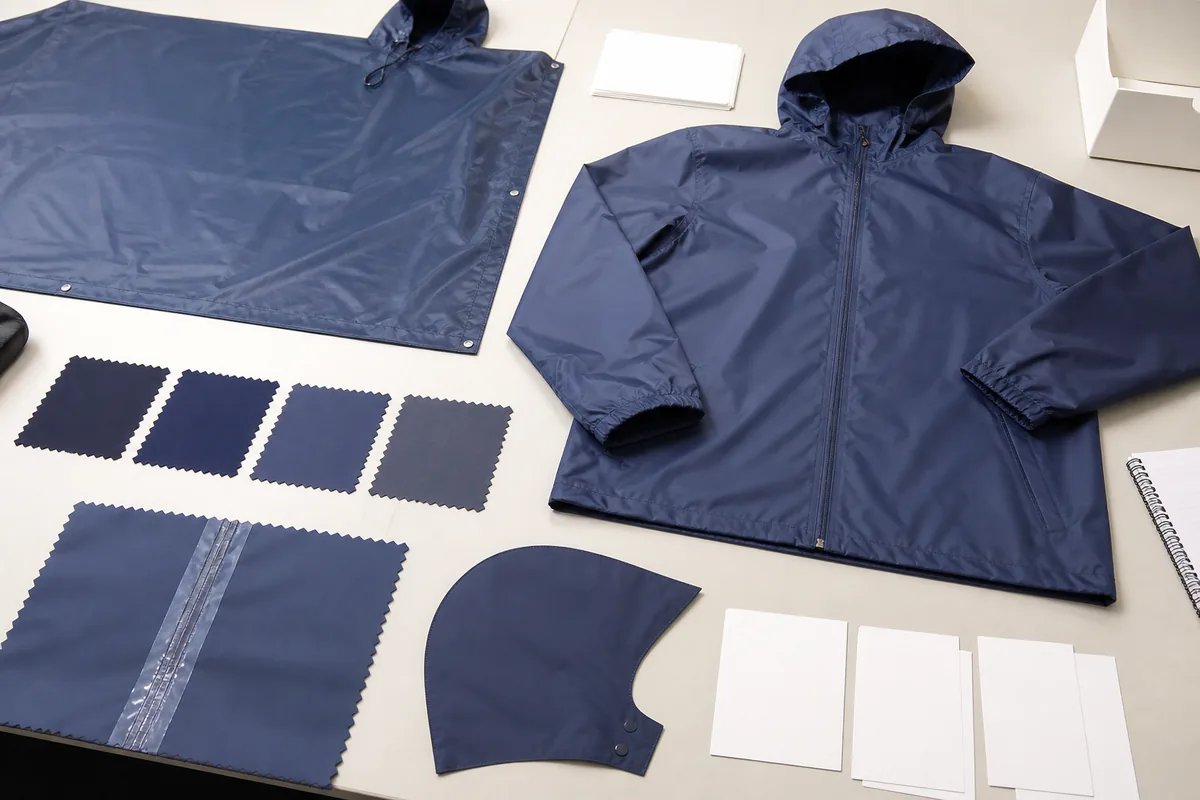
Buyer education path
Convert Material Questions and Field Symptoms into an Auditable Buying File
A procurement guide must do more than list garment features. It should show how observations become material questions, how sample trials close specific risks and how the accepted evidence remains attached to bulk and replenishment decisions.
Classify the observation before assigning a cause.
User notes, photographs, textile coupons and complete-garment trials operate at different evidence levels. Record the object, environment and revision before using any result to change the specification.
How to use this guide
Enter at the section matching the unresolved risk, capture the required decision output and transfer only those open fields into the companion Product RFQ. Third-party observations remain research, not EverBen promises.
Guide 01 · Decode the name
Treat Polyester Rainwear as a Layered Product System, Not a Fiber Claim
The buying task begins by separating the substrate, barrier, surface finish, lining and finished-garment interfaces. A fiber label answers only one part of the decision.
Layer map
Ask what sits on each side of the polyester textile
Request an outside-to-inside description that names the visible face, base textile, optional top finish, separate barrier construction and wearer-side layer. Mark the tape-bonding face and any lining contact. This prevents quotations from hiding materially different products behind the same fiber name.
A coated fabric, laminated structure and surface-treated woven can all be described loosely as polyester rainwear. Use controlled swatches and supplier codes to attach the words to an exact specimen.
Evidence state
Separate material identity from a performance result
Composition, weave, denier, mass, coating and finished test results answer different questions. Record every value with its unit, method, specimen and source. If a number is only a buyer target or supplier proposal, label that state instead of presenting it as achieved.
A fabric report does not automatically include seams, zipper, hood, pockets or production workmanship. Match evidence to the object covered by the claim.
Language
Translate consumer adjectives into buyer-owned checks
Words such as lightweight, breathable, durable, soft and waterproof are incomplete until the buyer defines a comparison or method. Use finished weight, approved hand reference, wearer trial, named test or agreed use challenge as appropriate.
Avoid substituting one attractive adjective for another. The purpose is to create a repeatable decision that survives supplier and production handoffs.
Guide 02 · Substrate literacy
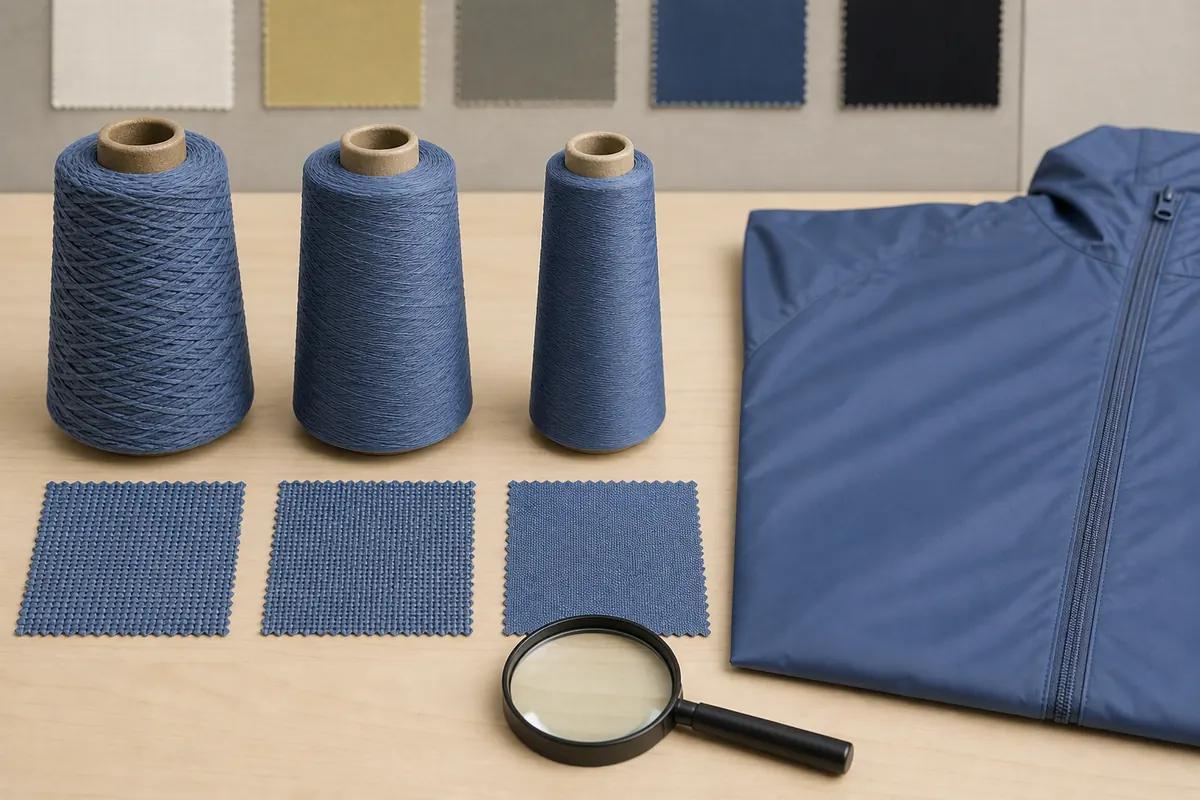
Read Denier, Yarn, Weave and Finished Mass without Creating a False Ranking
Material numbers become meaningful only when the measurement convention and complete construction are known. Use them to identify alternatives, not to declare one fabric universally better.
Denier
Understand what denier can and cannot tell you
Denier is a linear-density expression for yarn under a stated convention. It can help distinguish material constructions, but it cannot independently prove tear strength, abrasion life, waterproofness, softness or packability. Ask what yarn is being measured and how the woven and finished material is built.
Do not compare a face-yarn number from one supplier with a finished product claim from another. Keep units and objects aligned.
Weave
Examine weave density, texture and stabilization
Plain, ripstop, pongee, taffeta and Oxford labels can describe useful structural directions, yet supplier naming is not always identical. Review the actual texture, luster, drape, wrinkle behavior, dimensional stability and coating response.
A visible ripstop grid is not proof of a particular fiber, denier or strength result. Use material documentation when those facts are required.
Finished textile
Connect finished mass and hand to the garment job
Coating, lamination, finish and lining can change mass and feel after the base textile is formed. Compare finished swatches and garments, not only greige or face-fabric numbers. Record the condition and tolerance if mass enters the purchase specification.
A heavier route can improve one risk while increasing heat, stiffness and packed volume. Choose by the operating job rather than a single metric.
Guide 03 · Barrier choice
Compare Coating and Lamination Routes through Use, Aging and Assembly
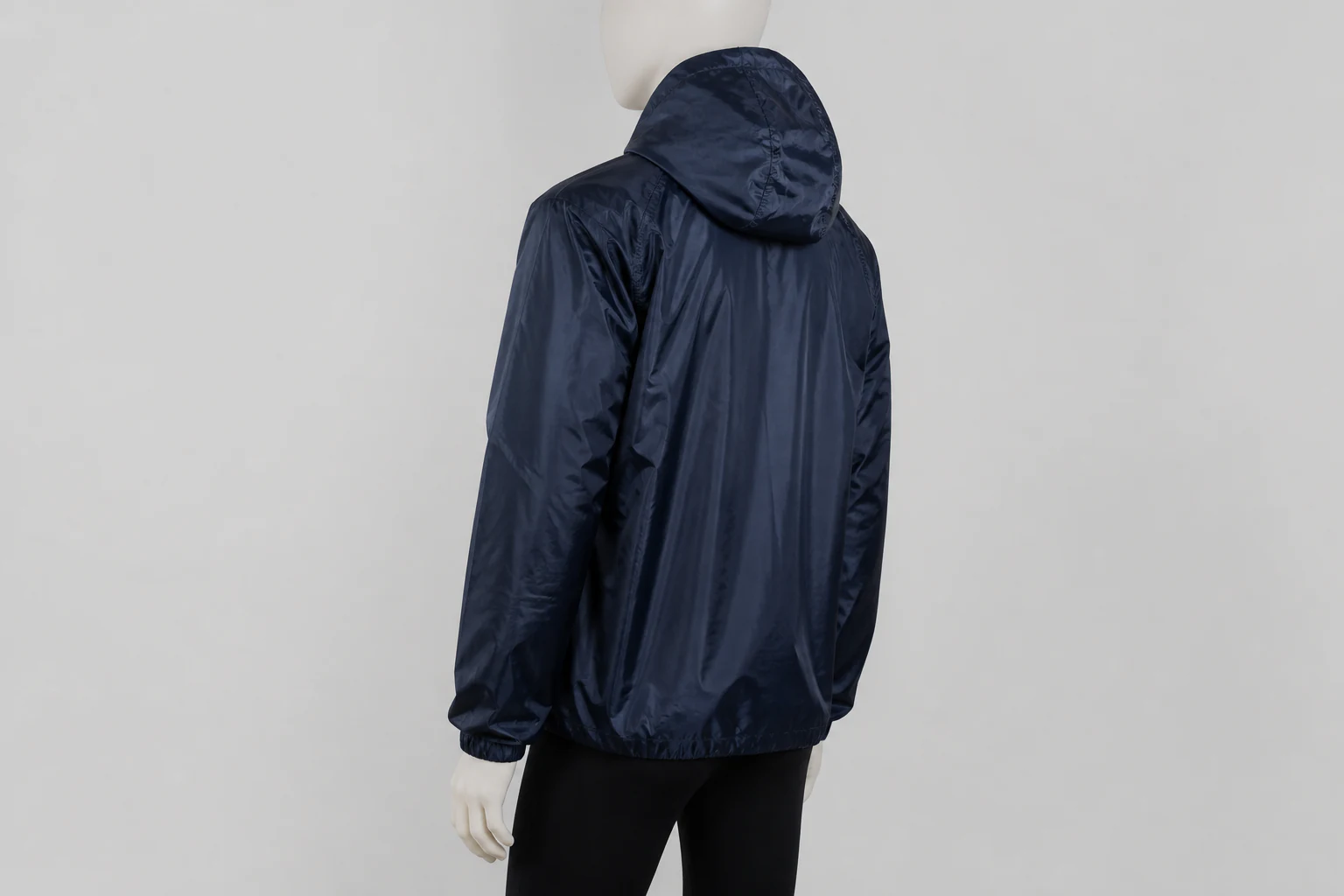
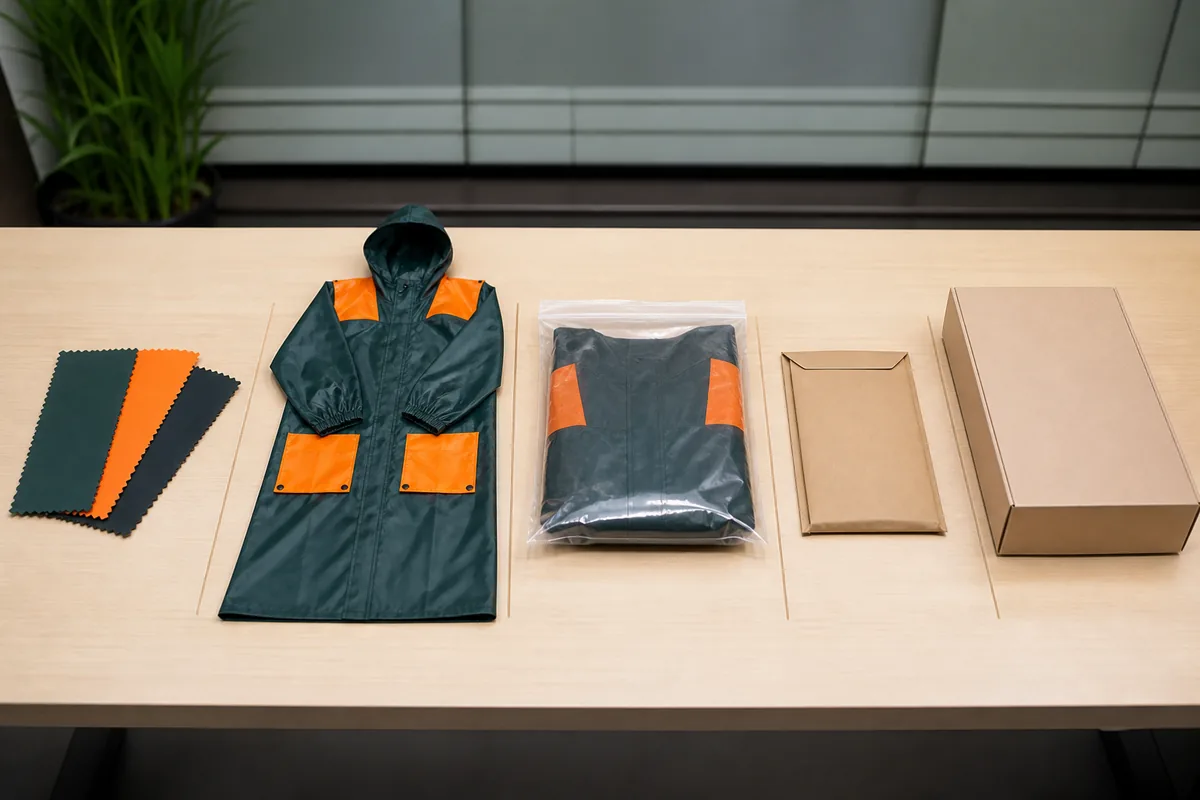
A barrier route affects hand, seam-tape compatibility, moisture behavior, care, folding and evidence. Compare the whole system rather than ranking chemistry names in isolation.
Construction
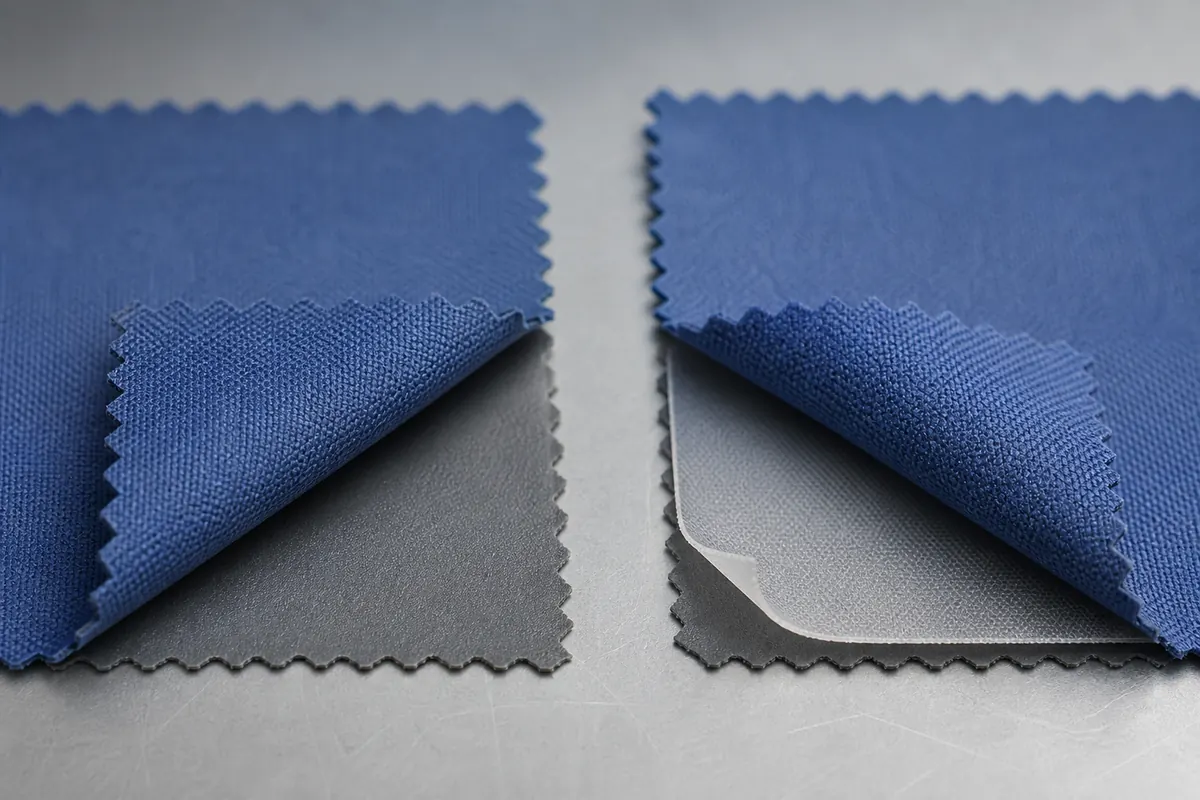
Distinguish direct coating from bonded layers
A direct coating applies a polymer system to a textile surface, while a laminate bonds separate layers. Either route can vary in formulation, coverage and finish. Ask for the actual layer stack, wearer side, finished mass and compatible joining method.
Do not assume every PU, PVC or TPU reference behaves alike. Chemistry labels are not complete purchasing specifications.
Aging
Ask how the route is challenged after folding and storage
Repeated folding, pressure, temperature, humidity, abrasion and care can expose blocking, cracking, delamination, print transfer or tape lift. Select challenges based on the real service and pack model and record specimen, condition and observation.
A new flat swatch cannot prove long-term garment behavior. Keep durability wording limited to the evidence actually obtained.
Assembly
Join material choice to seam, print and trim compatibility
Tape heat, sewing needle, reinforcement, decoration cure and component attachment all interact with the barrier and backing. Build coupons using production materials and settings, then confirm critical locations on a finished sample.
If the material or settings change, define when earlier compatibility evidence must be reopened.
| Buyer observation | Record immediately | Construction to examine | Premature conclusion to avoid |
|---|---|---|---|
| Narrow damp track | First location, rain direction, posture and elapsed wear time | Nearest seam junction, tape end, flap or pocket entry | The entire textile barrier failed |
| Broad inner humidity | Activity, temperature, base layers and vent use | Lining contact, internal airflow and wet cuff transfer | Water penetrated every panel |
| Hem lift during reach | Wearer size, clothing layers and exact movement | Shoulder balance, sleeve articulation and body length | Increasing every dimension will solve it |
| Decoration changes after packing | Material color, cure route, fold contact and storage condition | Printed location, coated face, trim pressure and bag arrangement | The digital artwork approval covered packed behavior |
Guide 04 · Failure diagnosis
Diagnose Wetness by Location, Timing, Movement and Likely Entry Path
Not every damp interior means the base fabric failed. Separate rain entry, seam leakage, opening exposure, condensation, wet-layer transfer and user operation before changing the design.
Observation
Record the first observed location and event sequence
Ask where moisture first appeared, how long the garment had been worn, which direction rain and wind came from, and what the wearer was doing. Photograph the inside and outside location when possible and note the sample identity and condition.
A generalized statement such as the coat leaked loses the evidence needed to distinguish material, seam, closure or fit causes.
Root path
Trace the corresponding construction path
Map the wet location to nearby shoulder, hood, sleeve, pocket, zipper, flap, cuff, hem or waist-overlap interfaces. Inspect tape continuity, seam junctions, drainage and the way the worn garment folded during movement.
Water can travel along lining or seams before becoming visible. The first visible spot may not be the original entry point.
Internal climate
Separate external entry from internal moisture and transfer
Review activity level, temperature, layers, vent use and whether cuffs, gloves or inner garments were already wet. Condensation and transfer require different corrections from a barrier or seam defect.
Do not use this distinction to dismiss a complaint. Recreate the condition and document what the evidence supports.
Guide 05 · Compatibility trial
Build a Seam and Opening Challenge around the Actual Coated Textile
Straight coupons are useful first gates, but finished curves, overlaps and closures must also be reviewed. The trial should reproduce the material, settings and interface geometry that will ship.
Screening
Use coupons to screen tape, sewing and print variables
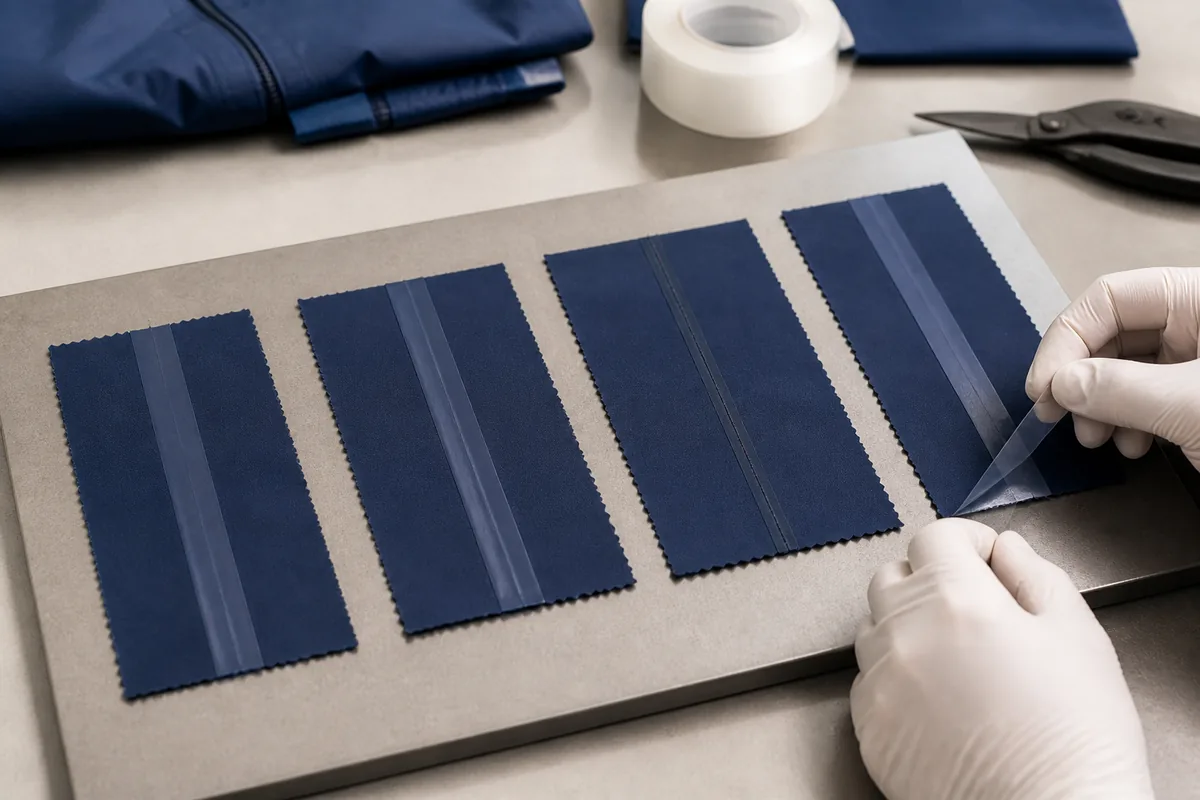
Prepare controlled samples for tape adhesion, overlap, needle path, reinforcement and artwork. Record material code, face or reverse, machine settings, operator or line, date and result. Coupons allow efficient comparison before full garment development.
A coupon should answer one defined question. Do not use a successful straight strip as unlimited proof for every seam junction.
Geometry
Challenge curves, bulk and opening terminations
Build hood curves, shoulder crossings, zipper ends, pocket corners and tape overlaps using production-like allowances. Inspect lift, channel, puckering, skip, distortion and the surrounding coating after conditioning or use challenge.
These locations combine geometry and process load. Give them named checkpoints in the sample and in-process inspection record.
Change control
Define change triggers before bulk production
List changes in fabric, backing, color route, tape, thread, zipper, print, settings or factory process that require review. Assign who may approve the change and what evidence must be repeated.
A written trigger prevents convenience substitutions from inheriting evidence generated for a different system.
Guide 06 · System interaction
Review Fit, Artwork and Pack Pressure as Interacting Decisions
Pattern movement changes artwork and seam positions; decoration changes hand and fold behavior; packing can press coated faces and trims together. Approve the connected system.
Fit first
Freeze movement fit before final artwork placement
Check reach, bend, sit, hood turn and layered overlap across representative sizes. Mark the worn position of seams, pockets and reflective elements. Artwork placed on a flat pattern can shift, crease or cross high-flex zones after grading.
Keep body and garment measurements distinct, and record the layer set used for the trial.
Artwork
Qualify branding on the intended color and coating
Trial the authorized logo at production size and location. Review cure, adhesion, opacity, stiffness, puckering, needle holes and care or fold challenges relevant to the project. A screen image proves layout only.
Color and surface gloss affect appearance. Approve the actual material route under an agreed viewing condition.
Pack challenge
Open packed samples after realistic pressure and storage
Use the final fold, bag, inserts and component arrangement. Examine blocking, transfer, creasing, trim impressions, moisture, odor and reopening presentation after a defined challenge. Connect issues back to material, cure, fold or storage.
A retail hanger sample and a compact issue pack require different approval evidence.
Guide 07 · Approval record
Convert Sample Comments into a Golden Reference and Bulk Acceptance File
Approval is durable only when the sample, specification, evidence and revision agree. Separate what the sample proves from what remains open and what bulk inspection must confirm.
Sample role
Give every sample a purpose and revision identity
Label swatch, construction coupon, fit sample, size set, pre-production sample and packed sample by date and revision. State the decisions each is intended to close and the tests or comments still pending.
Avoid calling an early development garment the golden sample when later materials, measurements or artwork are unresolved.
Controlled file
Create a linked approval dossier
Connect bill of materials, drawings, measurement chart, color and artwork proof, component references, evidence register, comment log and pack specification to the approved pre-production garment. Identify the authoritative version.
A physical sample without its records is difficult to reproduce; a document set without a matching specimen can hide interpretation gaps.
Release
Define bulk acceptance by risk and claim scope
List incoming, in-process and final checkpoints, defect examples, measurement tolerances, claim-critical evidence, sampling basis and deviation authority. Connect each result to the relevant lot and SKU.
A generic inspection statement cannot replace buyer-defined acceptance criteria. Agree the plan for the actual order.
Guide 08 · Supplier comparison
Normalize Supplier Quotes before Comparing MOQ, Timing and Price
Commercial values cannot be compared when suppliers assume different materials, constructions, evidence, size splits or packs. Normalize the task first and ask every source to expose deviations.
Baseline
Create one baseline specification and deviation column
Issue the same product architecture, material direction, measurements, artwork, evidence and pack assumptions to each supplier. Require a line-by-line deviation list and identify proposed alternatives rather than allowing silent substitutions.
If a field is open, ask every source to propose it with the same output format and evidence state.
Scope
Separate included work from optional or buyer-owned work
Compare sample rounds, tooling, custom material or color, component development, testing, inspection, individual packing, carton marks, freight assumptions and buyer-provided files. Ask which events trigger requotation or schedule change.
The lowest headline number may omit a different task. Compare the complete responsibility map.
Continuity
Protect repeat orders and destination changes
Request material and component availability, substitution notification, retained-reference practice, quotation validity and the process for new size or destination allocations. Confirm which evidence remains applicable and which must be refreshed.
A reorder is not automatically identical. Treat changed sources, processes, markets and claims as controlled decisions.
Procurement questions for coated polyester programs
Polyester Rainwear Buying Questions Procurement Teams Ask
Is polyester itself waterproof?
The fiber label does not establish rain protection. Buyers must examine the woven base, applied barrier, exterior treatment, joined panels and every opening, then bind the requested statement to evidence from the identified material or complete SKU.
Does a higher denier always mean better rainwear?
No. Denier identifies yarn linear density under a convention; it does not independently prove waterproofness, tear strength, softness or service life. Compare the complete woven and finished construction for the intended job.
What is the difference between a coating and a laminate?
Direct-coated textiles carry an applied barrier on a fabric face; laminated constructions join separately formed layers. Either route varies by formulation and build. Record the represented stack, wearer side, joining method and project evidence.
Why can the inside feel wet when the fabric does not visibly leak?
Rain can enter at seams or openings, but wearer moisture, condensation and transfer from wet cuffs or layers can also create dampness. Diagnose location, timing, activity, layers and garment interfaces before choosing a correction.
What should a seam compatibility trial include?
Use the exact fabric, coating side, tape or seam method and production-like settings. Start with coupons, then challenge curves, overlaps, zipper ends and bulky junctions. Record change triggers that require renewed review.
Which records make supplier quotes comparable?
Issue a single technical baseline, then collect each source's departures, included development work, evidence responsibilities, assortment basis, pack configuration, commercial validity and change-notification approach. Buyers can then see the workload and risk behind each total.